
7 Startup Naming Tips for Founders Launching B2B SaaS in 2026
7 Startup Naming Tips for B2B SaaS Founders in 2026
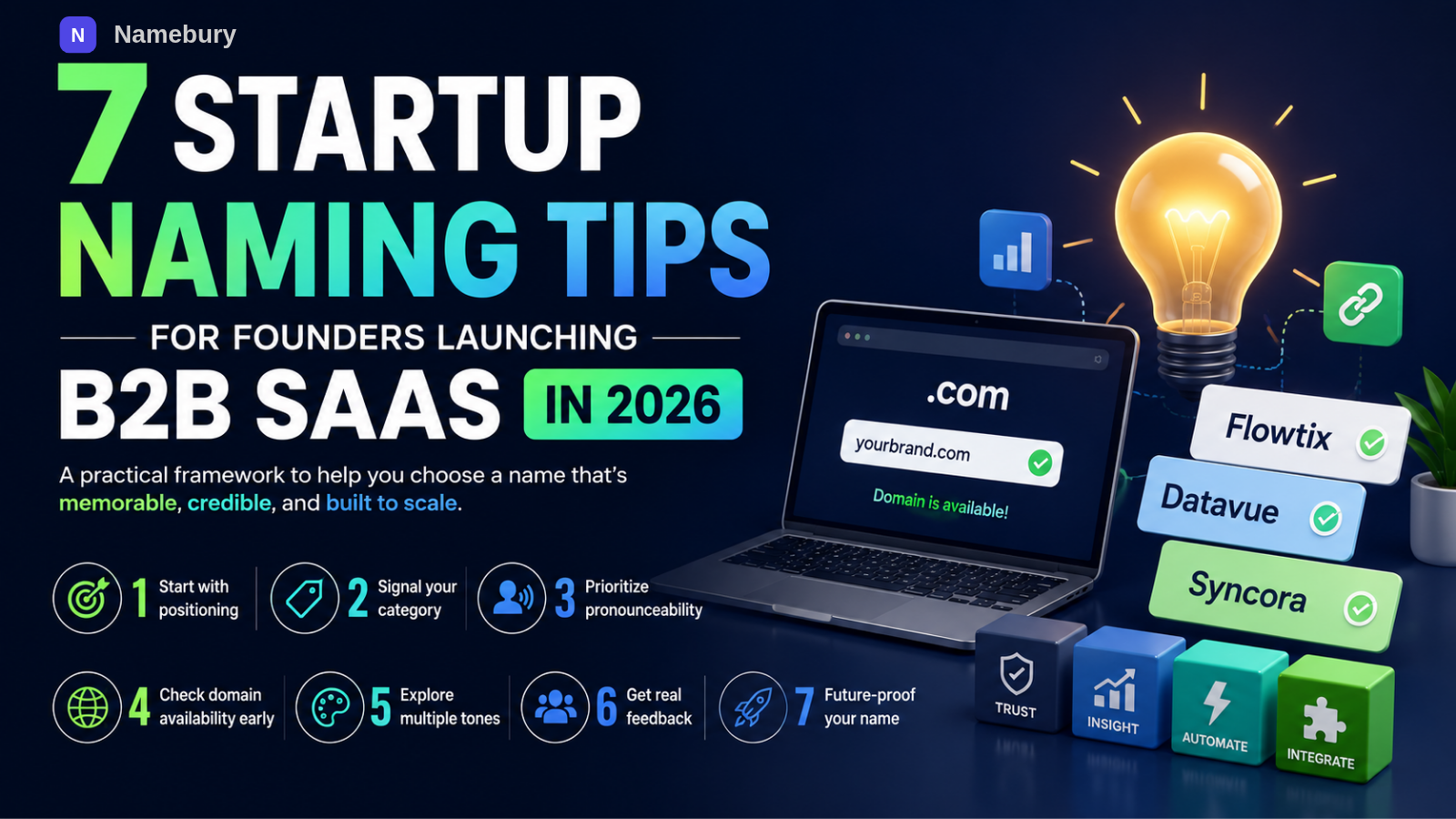
Naming a startup sounds simple until you actually have to do it. For first-time founders launching B2B SaaS products in automation, analytics, or integrations, the stakes are higher than they look. Your name has to feel credible in a sales deck, clear in a cold email, memorable after a demo, and available enough to use across a domain, social profiles, and product surfaces.
In 2026, founders are naming in a more crowded market than ever. The best names are no longer just "creative." They need to send the right professional signal, be easy to say and spell, and fit the kind of company you want to become.
Here’s a practical naming framework built for early-stage B2B SaaS teams.
1. Start with positioning before brainstorming names
The biggest naming mistake founders make is starting with wordplay before they define what the company actually needs to communicate.
Before you list a single name idea, answer these questions:
Who is the buyer: operations leaders, RevOps teams, data teams, IT, finance, or SMB owners?
What category are you entering: workflow automation, analytics, integrations, AI infrastructure, or something adjacent?
What do you want prospects to feel: trust, speed, precision, modernity, or enterprise readiness?
What kind of company are you building: serious and technical, or accessible and product-led?
A founder building compliance automation for enterprise finance teams should not use the same naming style as a startup making lightweight reporting tools for Shopify brands. Positioning comes first. Naming comes second.
When your positioning is clear, your name becomes easier to judge. Instead of asking, Do we like it? you can ask, Does it fit the market we want to win?
2. Choose words that signal your category without sounding generic
B2B SaaS names work best when they give some hint about the product space without sounding like every other startup in the category.
That means avoiding names that are so abstract they communicate nothing, but also avoiding names built from overused SaaS fragments that blur together. If your name sounds interchangeable with five competitors, it will be harder to remember and harder to search.
Good category-signaling words often evoke ideas like:
Flow, sync, route, automate, connect
Signal, metric, insight, pulse, track
Layer, stack, bridge, node, logic
Secure, audit, policy, verify, trust
The goal is not to describe the product literally. It’s to create the right mental neighborhood. A strong name helps a prospect think, I can tell this is in the world of integrations or This sounds like a serious analytics platform.
That said, be careful with terms that have become naming clichés. If a word appears in dozens of startup names, it may weaken differentiation even if it fits your category.
3. Prioritize pronounceability over cleverness
Founders often overvalue novelty and undervalue clarity. In B2B SaaS, a name that is easy to pronounce, spell, and repeat usually beats a clever but confusing alternative.
This matters because your name will be used in:
Word-of-mouth referrals
Sales calls and demos
Podcast mentions
Conference intros
Slack messages and email threads
If someone hears your company name once, can they type it correctly into a browser? If they see it written, can they say it out loud with confidence? If the answer is no, friction goes up everywhere.
A few practical filters help:
Avoid awkward letter combinations
Avoid intentional misspellings unless they are extremely intuitive
Avoid names that sound too similar to common words with different spelling
Prefer simple syllable structures over tongue-twisters
Professional buyers do not reward naming puzzles. They reward clarity. Cleverness is only useful when it does not create confusion.
4. Test for domain availability early, not at the end
Too many teams brainstorm for days, pick a favorite, and only then check whether the domain is available. By that point, they are emotionally attached, which makes compromise harder.
Instead, test domain availability early in the process. You do not need the perfect domain on day one, but you do need realistic options.
For B2B SaaS in 2026, founders commonly consider:
.com when available and affordable
get[brand].com or use[brand].com as transitional options
Modern alternatives when they still feel credible for the audience
For enterprise-facing products, domain professionalism matters. A strong name paired with a weak or awkward domain can reduce trust, especially in outbound sales and procurement-heavy environments.
That is why domain testing should be part of ideation, not a cleanup step. The faster you can screen ideas against real-world availability, the faster you can focus on viable candidates.
5. Generate multiple tones: trustworthy, technical, playful, enterprise
One of the smartest naming exercises is not generating more names randomly. It is generating names by tone.
Ask what style best matches your product, buyer, and go-to-market motion. For example:
Trustworthy: strong for compliance, finance, security, and infrastructure tools
Technical: useful for developer tools, data products, and integration platforms
Playful: can work for SMB-focused or product-led tools with a lighter brand voice
Enterprise: best when selling to larger organizations that value stability and professionalism
Most founders discover they are too narrow in their first round of naming. They generate one style only, often based on personal taste. But a name should serve the market, not just the founder’s preferences.
This is also where AI can be especially useful. An AI naming and domain tool can generate many name directions across different tones and constraints in minutes, helping founders compare options they might not have considered manually. Instead of brainstorming in a vacuum, you can quickly test combinations based on category signals, length, spelling simplicity, and domain viability.
6. Check basic trademark risk before falling in love with a name
Domain availability is not the same as legal safety. A name can have an open domain and still create trademark issues, especially if it overlaps with an existing software company in a similar class.
You do not need to run a full legal process on every rough idea, but you should do a basic risk screen before moving a name onto your final shortlist.
At minimum, check:
Whether similar companies already exist in your category
Whether there are obvious software trademarks that conflict
Whether the name is too close phonetically or visually to a known competitor
Whether the name could create confusion in search results or sales conversations
Once you narrow to a few serious candidates, it is worth getting legal guidance. That small step can save expensive rebranding pain later.
The key lesson: do not fall in love too early. A startup name is not real until it survives both brand and legal filters.
7. Shortlist names that look strong in pitches, onboarding, and social posts
A name does not live in isolation. It lives inside your entire go-to-market system.
Once you have a shortlist, test each option in realistic contexts:
On a pitch deck title slide
In a homepage hero
Inside the product onboarding flow
In a LinkedIn post from the founder
In a cold email signature
As a logo wordmark
This step is underrated. Some names sound good in a brainstorming session but feel weak when placed in real business environments. Others become much stronger once you see them in a deck or product UI.
Ask practical questions:
Does it look credible next to customer logos?
Does it feel too small or too playful for the buyers you want?
Will an SDR feel confident saying it on a call?
Does it still work if the product expands beyond the first feature set?
A strong B2B SaaS name should hold up across brand, sales, product, and content. If it only works in one context, it is probably not the right one.
Bonus: How founders can use AI to save hours on naming research
Startup naming used to mean whiteboards, thesaurus tabs, and endless domain searches. Now founders can compress a large part of that work by using AI to generate, organize, and filter naming options faster.
A good AI naming workflow can help you:
Generate names by category and tone
Explore alternatives you would not think of manually
Filter for short, pronounceable, brandable options
Test domain constraints earlier
Compare serious, technical, and modern brand directions side by side
For early-stage teams, that speed matters. You do not want to spend weeks debating names that fail obvious checks. An AI domain tool is especially useful because it combines creative exploration with practical screening, giving founders a faster way to test multiple tones and constraints before choosing a final name.
AI will not make the decision for you. But it can dramatically improve the quality of the options you evaluate and reduce the time wasted on dead ends.
Final thoughts
The best startup names for B2B SaaS in 2026 are not the most abstract or the most clever. They are the ones that make the right impression quickly: credible, clear, easy to spell, and aligned with the market you want to win.
If you are naming an automation, analytics, or integration startup, start with positioning, generate across tones, test domain availability early, and screen for legal risk before you commit. Most importantly, choose a name that works in the real places your brand will live: sales decks, onboarding flows, social posts, and customer conversations.
A great name will not build the company for you. But it can make every introduction a little easier.