
.com vs .io vs .ai: What Early-Stage Founders Should Prioritize When the Perfect Domain Is Taken
.com vs .io vs .ai: Which Domain Should Startups Choose?
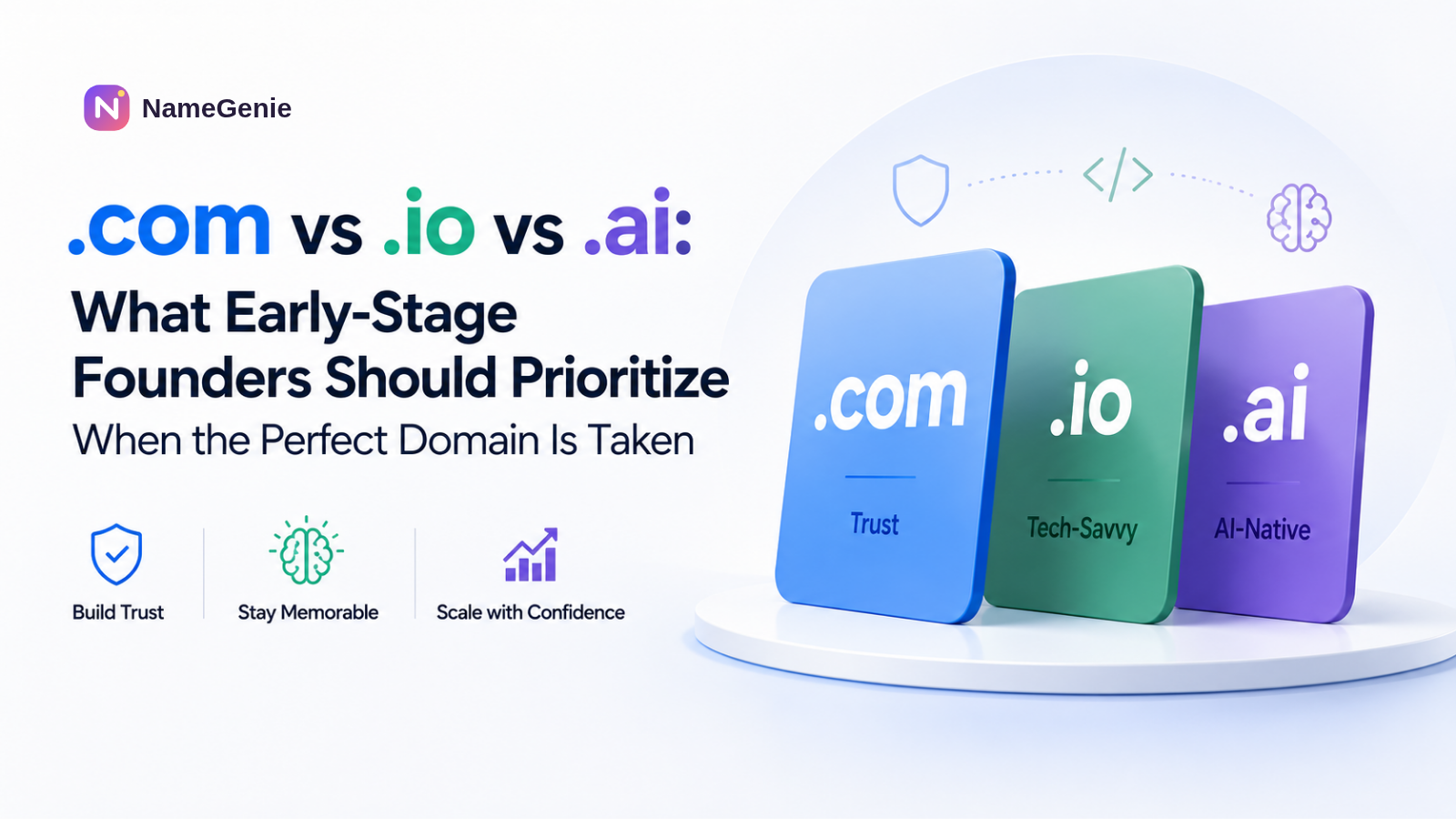
For early-stage founders, domain decisions have a way of feeling bigger than they are. You find a strong startup name, check availability, and discover the .com is already taken. Suddenly you're comparing .io, .ai, and a dozen other options, wondering whether the wrong choice will hurt credibility, growth, or fundraising.
The good news: this decision matters, but not as much as many founders think. In most cases, the right domain is the one that supports trust, is easy to remember, fits your market, and doesn't drain time or budget that should go toward building the company.
This guide breaks down how to think about .com vs .io vs .ai in a practical way—especially when the perfect domain is gone.
Why the Best Startup Name Is Often Taken in .com
Most short, clean, brandable .com domains were registered years ago. Some are attached to active businesses. Others are held by investors or parked for resale. That means founders today are often choosing from one of four realities:
- The exact .com is unavailable but another TLD is open
- The .com is available only at a high aftermarket price
- The name can be modified slightly to get a workable .com
- The team needs to choose a different brand name entirely
This is normal. It is not a sign that your branding process has failed. The internet matured a long time ago, and domain scarcity is now part of startup naming.
The key is not to obsess over getting the perfect domain at any cost. The key is to make a decision that is strategically good enough for your stage.
What .com Still Signals to Customers and Investors
Even with the rise of alternative TLDs, .com still carries the strongest default trust signal. It feels familiar, established, and broadly credible across audiences.
That matters most when your startup serves:
- Mainstream consumers
- Traditional small and mid-sized businesses
- Enterprise buyers outside tech circles
- Investors who value conventional market presentation
Why does .com still matter? Because people instinctively type it, assume it, and remember it. If your company is called BrightPath and your domain is brightpath.io, many people will still try brightpath.com first. That creates leakage, confusion, and extra friction.
.com also tends to age well. A startup may begin in a niche technical space but grow into a broader platform over time. A .com usually stretches with that ambition better than a more trend-driven extension.
That said, founders should not interpret this as "always pay whatever it takes for the .com." If the domain costs $50,000 and your startup is pre-seed, that money may be better spent on product, runway, or customer acquisition. Trust matters, but so does capital discipline.
When .io Makes Sense for Developer or SaaS Products
.io has become a familiar choice in startup and software circles, especially for developer tools, infrastructure products, APIs, and modern SaaS brands.
It often works well when:
- Your audience is highly technical
- Your buyers are startup-savvy or software-native
- Your brand positioning is modern, product-led, or developer-first
- The matching .com is unrealistic or unavailable
For example, if you're building a deployment tool, analytics platform, or engineering workflow product, a .io domain may feel perfectly natural to your users. In those categories, it can even signal that the company understands the ecosystem it serves.
But .io has limits. Outside tech, it can be less intuitive and less memorable. Some users won't know whether it's a real company URL, and others may forget the extension entirely. If your business depends on word-of-mouth referrals or broad consumer recall, this matters.
Use .io when it aligns with your audience—not just because it feels startup-ish.
When .ai Helps—and When It Feels Forced
.ai can be powerful when artificial intelligence is central to the product and brand story. It immediately communicates a category association, which can be useful if you're building an AI-native product and want the market to understand that quickly.
It tends to work best when:
- AI is core to the product, not just a feature
- Your buyers actively look for AI solutions
- Your positioning benefits from clear category signaling
- The brand name sounds credible with the extension
For instance, a model evaluation platform, AI coding assistant, or workflow automation product may benefit from a strong .ai pairing.
However, .ai can feel forced when the company is only lightly connected to AI or is using the extension mainly to appear trendy. If your product is essentially a standard SaaS tool with one AI feature, a .ai domain may overpromise. That can create skepticism rather than excitement.
Another consideration is longevity. If your brand outgrows the AI label, the extension may become limiting. Founders should ask whether they want the company tied this tightly to a specific technology wave five years from now.
How Alternative TLDs Affect Trust and Recall
Alternative TLDs are not inherently bad. But they do change the trust and memory equation.
Here are the main tradeoffs:
Trust
.com wins by default for broad trust. .io performs well in tech. .ai performs well in AI-aware markets. The more specialised the extension, the more audience context matters.
Memorability
A great domain is easy to say, spell, and remember. Alternative TLDs can reduce memorability if users forget the extension or assume .com. This is especially risky when the matching .com belongs to another live business.
Positioning
.io and .ai can sharpen positioning. They quickly signal "software" or "AI." That can help early traction if the signal is accurate. But if the extension does too much of the branding work, the company may feel narrower than intended.
Brand Leakage
If people hear your company name on a podcast, in conversation, or at an event, where do they go? If they instinctively type the .com and land somewhere else, you've created avoidable leakage.
In other words, alternative TLDs can work well, but they require more intentionality.
Questions to Ask Before Choosing a Non-.com Domain
Before committing to .io or .ai, founders should run through a few practical questions:
- Who is the primary audience right now?
- If they are technical users, .io may be fine. If they are mainstream or non-technical buyers, .com usually has an advantage.
- Will people naturally assume the .com?
- If yes, check what exists there. A parked page is one thing. A real company in a similar space is another.
- Does the extension reinforce or distort the brand?
- .ai should support a real AI story, not manufacture one.
- How important is word-of-mouth discovery?
- If referrals matter heavily, choose the option with the least spelling and recall friction.
- Can you afford the .com later if needed?
- Some startups launch on an alternative TLD and acquire the .com later. That can be a rational path if the current choice is strong enough.
- Are you making a smart compromise or a messy one?
- A clean alternative TLD is often better than a clunky .com stuffed with hyphens, odd spellings, or random prefixes.
Examples of Good and Bad Compromise Decisions
Not all compromises are equal. Here are a few useful patterns.
Good compromise: clean brand + relevant alternative TLD
Example: signalstack.io for a developer observability tool.
This works because the name is clear, the audience is technical, and the extension fits the category.
Good compromise: slightly modified .com that remains brandable
Example: joinnorth.com or getnorth.com for a product called North.
This can work if the modifier is simple, intuitive, and unlikely to create confusion.
Bad compromise: awkward .com at the expense of brand quality
Example: try-use-northhqonline.com.
If securing a .com makes the name ugly, forgettable, or hard to share, the tradeoff is not worth it.
Bad compromise: trendy extension with weak strategic fit
Example: a generic project management tool using .ai when AI is barely part of the product.
This may look opportunistic and can create expectation gaps.
Good compromise: launch now, upgrade later
Example: starting on withatlas.io while the team validates demand, then acquiring atlas.com after a fundraise or traction milestone.
This approach works best when the interim domain is still clean and credible.
How an AI Domain Generator Can Surface Options Across Multiple TLDs at Once
One reason founders get stuck is that they evaluate domains too narrowly. They fixate on a single exact name, then bounce between overpriced .com listings and random alternatives without a structured process.
An AI domain generator can help by expanding the search intelligently. Instead of checking one name at a time, it can generate brandable options across multiple TLDs based on your product, audience, and positioning.
That is useful because it lets you compare options like:
- Exact-match brand names in .io or .ai
- Slightly modified but still strong .com options
- Names better suited to technical versus mainstream audiences
- Shorter, more memorable alternatives you may not have considered
The best use of an AI domain generator is not to find something clever for its own sake. It is to widen the decision set so you can choose a domain that balances brand quality, availability, and strategic fit.
Final Take: What Founders Should Prioritize
If the perfect .com is taken, do not panic. Start with the basics:
- Prioritize trust if you're selling to broad or traditional markets
- Prioritize audience fit if you're choosing between .io and .ai
- Prioritize memorability over cleverness
- Prioritize speed and practicality over endless domain hunting
In simple terms:
- Choose .com when trust, broad appeal, and long-term flexibility matter most
- Choose .io when you're building for technical users and want a credible modern software feel
- Choose .ai when AI is genuinely central to the company and the extension strengthens positioning
The best early-stage domain is rarely the theoretically perfect one. It's the one that helps you launch confidently, communicate clearly, and leave room for the company to grow.