
Easy to Spell Startup Names: The Hidden Growth Advantage Most Founders Ignore
Easy to Spell Startup Names: A Hidden Growth Advantage
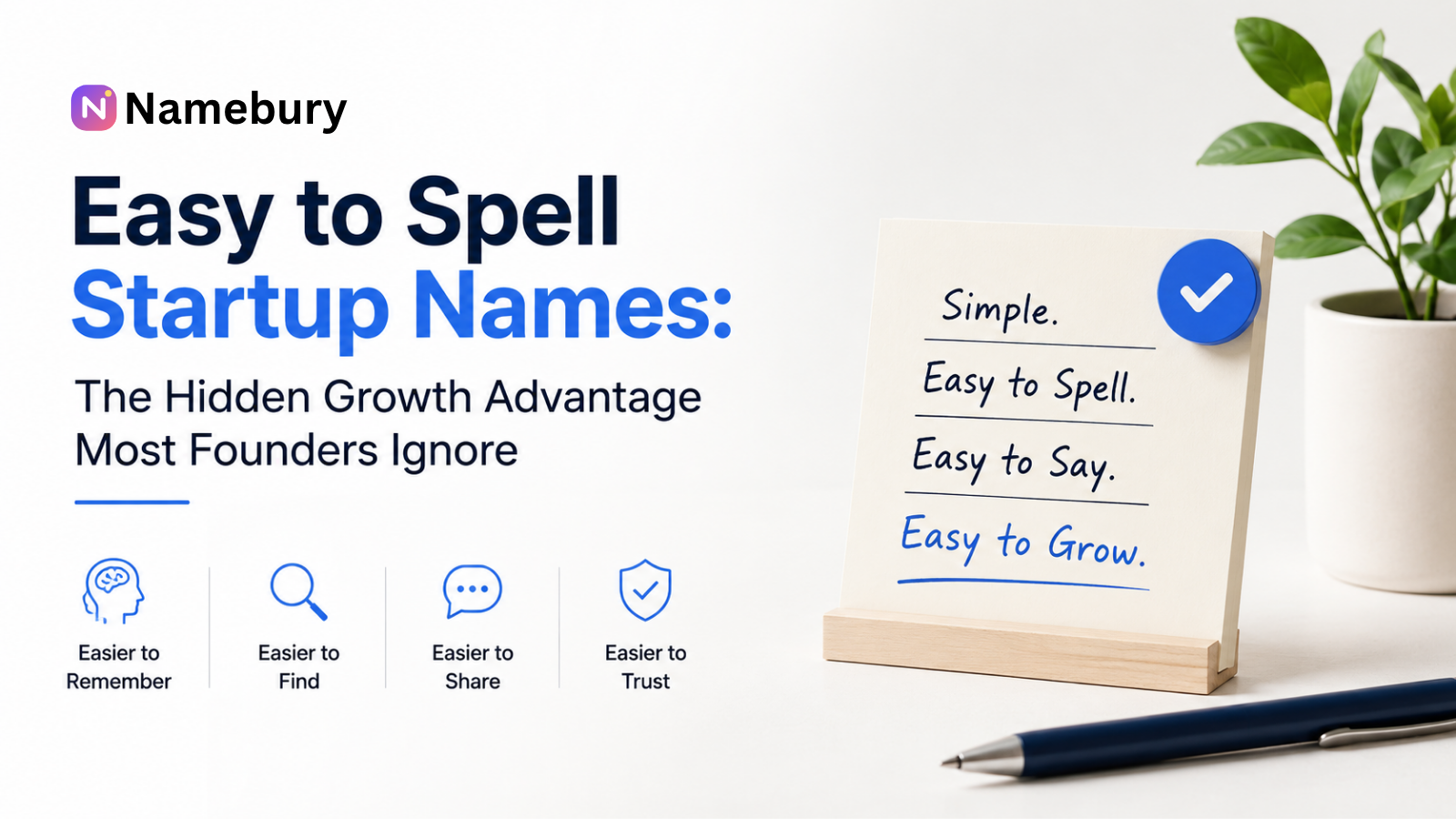
Most founders spend too much time asking whether a startup name sounds clever and not enough time asking whether a real person can spell it after hearing it once.
That sounds like a small detail. It is not.
For an early-stage company, especially during the MVP phase, an easy to spell startup name can quietly improve nearly every growth channel that matters: direct traffic, referrals, demo follow-up, onboarding, trust, and recall. In contrast, a confusing name creates friction at exactly the moment you need momentum.
The contrarian truth is simple: clarity often beats creativity when a startup is new. If people cannot type your name, search for it, mention it in Slack, or repeat it to a teammate without hesitation, your brand is doing less work than it should.
Why easy spelling matters more than cleverness for new startups
Established brands can survive odd spelling because they already have distribution, repetition, and recognition. A new startup does not have those advantages. It has to earn attention in crowded inboxes, fast-moving conversations, and low-context product demos.
When your name is easy to spell, several useful things happen:
- People remember it faster. Simplicity reduces cognitive load.
- People type it correctly. That means fewer lost visits and fewer failed searches.
- People share it more confidently. They are more likely to mention it in meetings, Slack threads, texts, and emails.
- People trust it sooner. Clear names often feel more legitimate and less gimmicky.
Founders often underestimate how much early growth depends on these tiny moments. A name is not just branding. It is infrastructure for memory and referral.
The cost of confusing spelling in demos, word-of-mouth, and onboarding
A difficult name rarely fails in one dramatic way. Instead, it leaks opportunity everywhere.
1. Demo friction
You finish a promising call. The prospect likes the product. Later, they try to revisit your site or mention your company internally. But they cannot remember whether your name had a double letter, a dropped vowel, or an unconventional ending. That small hesitation lowers follow-through.
2. Word-of-mouth decay
Word-of-mouth is fragile. If one person says your startup name out loud and the next person spells it wrong, the chain weakens immediately. The easier the spelling, the more likely referrals survive from conversation to search bar.
3. Slack and internal sharing problems
Many early product recommendations now happen in Slack, Teams, Discord, and group chats. If your name is awkward to spell, people either avoid mentioning it or write it inconsistently. That inconsistency reduces searchability and makes your brand easier to forget.
4. Onboarding confusion
Early customers are still deciding whether you are credible. If your name feels forced or hard to parse, it adds subtle uncertainty. A clean, easily spelled name lowers friction and makes the product feel more approachable.
None of this sounds dramatic, but startups are often won or lost on cumulative friction. A name that creates even a 5% drop in recall, referral accuracy, or branded search can be more expensive than founders realize.
Tests to see if your startup name is easy to spell
You do not need a branding agency to pressure-test a name. You need a few practical usability checks.
The phone test
Say the name once out loud to someone and ask them to text it back to you. If they misspell it, that is a signal.
The coffee shop test
Imagine saying the name in a noisy room. Would someone know how to type it without clarification? If you constantly need to spell it letter by letter, it is probably too fragile.
The Slack test
Drop the name into a message and ask a few people to recall it an hour later. Can they reproduce it accurately from memory?
The domain test
If someone hears your brand on a podcast or in a meeting, will they guess the URL correctly on the first try? If not, you are creating avoidable traffic loss.
The no-explanation test
If your startup name requires a story to make sense, it may not be strong enough for early growth. Good names can have depth, but they should not need rescue.
Red flags: invented spellings, doubled letters, missing vowels, and forced abbreviations
Some naming patterns consistently create more confusion than value, especially for startups that have not yet earned brand familiarity.
Invented spellings
Replacing standard spelling with a "creative" version may look distinctive on a mood board, but it often hurts discoverability. If users have to guess whether the word uses an i, y, ie, or ee, the name becomes less useful.
Doubled letters
Extra letters are easy to forget and hard to hear. Names with unexpected double consonants or vowels often require correction and repetition.
Missing vowels
Vowel-stripped names can seem modern, but they also look ambiguous. They may work for highly funded brands with heavy exposure. For most startups, they create unnecessary friction.
Forced abbreviations
Condensing a concept into initials or awkward shorthand can make a name feel cold and forgettable. Unless the abbreviation is naturally intuitive, it usually reduces clarity.
The common theme is this: founders often choose names that look unique in isolation but perform poorly in real-world communication.
How to balance uniqueness with clarity
Easy to spell does not mean boring. It means usable.
The best founder-friendly startup names usually sit in the middle ground between generic and gimmicky. They feel distinct enough to own, but familiar enough to spell without effort.
Here are a few ways to strike that balance:
- Use recognizable word structures. Familiar phonetics improve recall.
- Prefer simple syllable patterns. Short, clean names are easier to repeat.
- Avoid unnecessary mutations. If a normal spelling works, that is usually the better option.
- Choose pronounceability over novelty. If people can say it, they can usually share it.
- Check for first-try typing accuracy. A name should survive real use, not just brainstorming sessions.
A useful rule: if your name is unique because it is clear, that is an asset. If it is unique because it is confusing, that is a liability.
Examples of founder-friendly naming choices
Founder-friendly names tend to have a few traits in common: they are pronounceable, visually clean, and easy to repeat after one exposure.
Examples of stronger naming directions include:
- Plain-language combinations like merging two familiar words in a straightforward way
- Real-word associations that suggest speed, clarity, security, or collaboration
- Lightly distinctive names that sound natural even if they are newly coined
- Single-word names with conventional spelling and strong verbal clarity
Examples of weaker directions often include names that:
- Swap letters for style
- Remove vowels to force a tech aesthetic
- Depend on punctuation or unusual capitalization
- Need constant explanation to be understood
In practice, a slightly less clever name that people can remember and type correctly will often outperform a more "brilliant" name that creates friction.
How AI can generate easy-to-spell names without losing brand fit
AI can be surprisingly useful in the naming process, not because it magically produces perfect brands, but because it can generate many viable options quickly and filter them around usability constraints.
Instead of prompting AI for names that sound futuristic or disruptive, founders should ask for names that meet practical growth criteria:
- Easy to spell after hearing once
- Easy to pronounce in English
- No doubled letters unless obvious
- No missing vowels
- Short and memorable
- Aligned with the product category or brand tone
This approach helps founders avoid a common trap: selecting names based only on originality. AI can widen the option set while keeping clarity central.
A strong workflow looks like this:
- Define your brand attributes and customer context.
- Generate a large list of names with simplicity constraints.
- Remove names with spelling ambiguity.
- Test survivors with real humans using recall and typing tests.
- Check domain and trademark feasibility.
- Choose the name that performs best in actual communication, not just internal preference.
Used this way, AI becomes a practical naming assistant rather than a creativity machine.
Final thought
Most founders ignore spelling simplicity because it feels too basic to matter. But that is exactly why it is a hidden advantage.
In the earliest stage of a startup, growth depends on whether people can remember you, trust you, and pass your name along without friction. An easy to spell startup name supports all three. It makes referrals cleaner, demos stickier, onboarding smoother, and your brand more credible before you have earned broad recognition.
Cleverness can wait. Momentum cannot.
If you are naming a new company, do not just ask, "Is this distinctive?" Ask the more valuable question: Can someone spell it correctly after hearing it once?