
How to Choose a Business Name That Sounds Like a Real Startup, Not a Random Generator
How to Choose a Startup Name That Sounds Real, Not AI-Generated
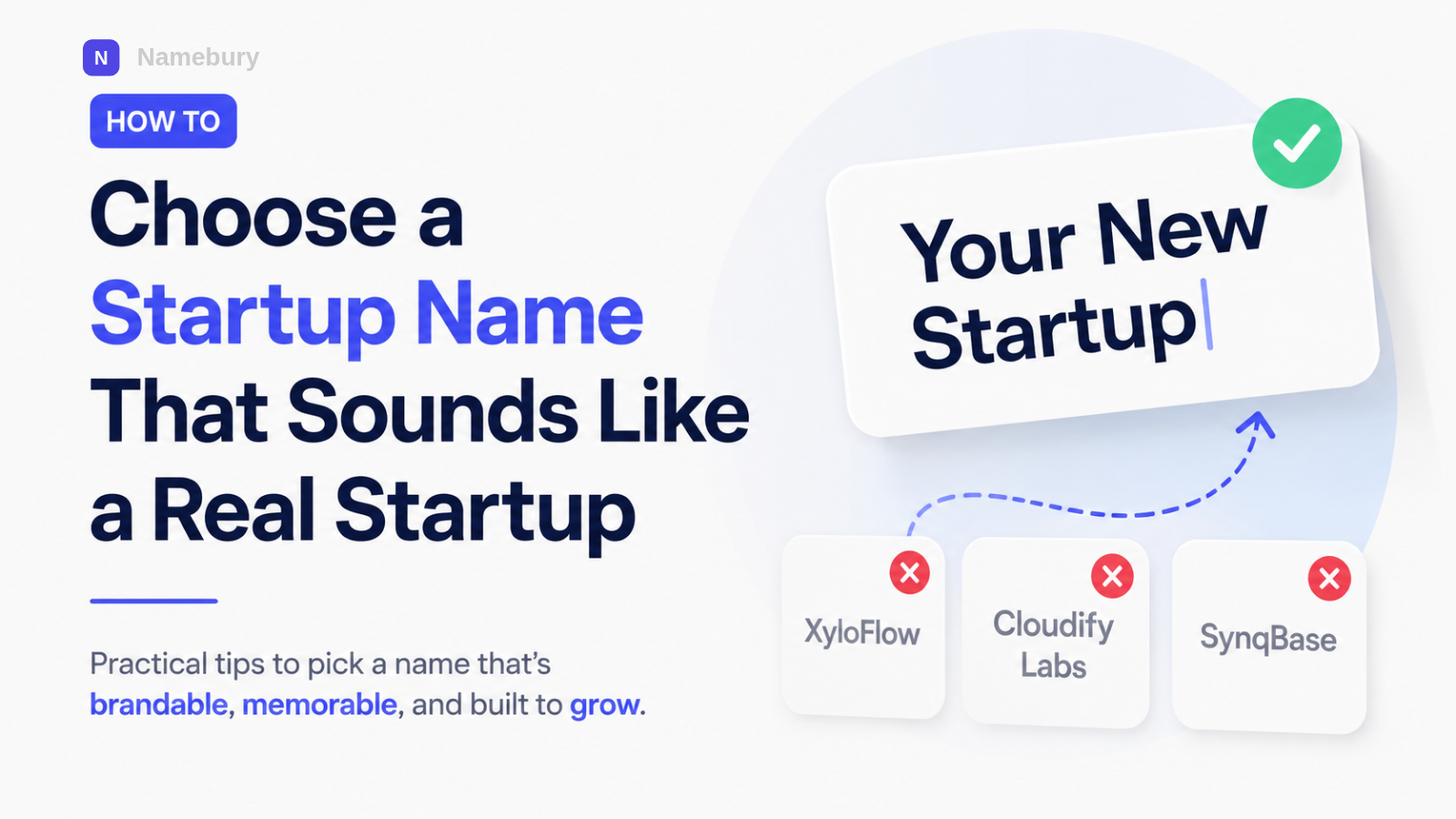
Founders are right to be skeptical about startup name generators. Most have seen the same pattern: a tool spits out a list of strange mashups, clipped syllables, and vaguely techy words that feel more like placeholders than brands. The result is usually disappointment, not clarity.
But the problem is not that AI naming tools exist. The problem is that many naming tools operate with almost no context. They combine words mechanically, ignore positioning, and treat every startup like it should sound the same.
If you want a business name that sounds like a real startup, the goal is not to avoid AI entirely. The goal is to use a naming process that reflects your niche, customer, tone, and domain constraints. That is what separates random outputs from names that actually feel launch-ready.
Why founders reject most generated startup names
Most generated names fail for predictable reasons. They are not wrong in a technical sense. They are wrong in a brand sense.
Founders usually reject generated names because they sound:
- Generic: like dozens of other software companies
- Artificial: as if they were assembled by formula
- Too broad: with no signal about the product or customer
- Too weird: hard to pronounce, spell, or remember
- Tonally off: playful when the market expects credibility, or stiff when the brand should feel modern
This objection is valid. If a founder is building a serious B2B SaaS platform, a random name that sounds like a gaming app will not work. If they are launching a modern service business, an overly corporate name can feel lifeless. Naming is not just about originality. It is about fit.
That is why the best startup names do not come from randomness. They come from constraints and intent.
The difference between random naming and context-aware naming
Random naming starts with words. Context-aware naming starts with strategy.
A random generator might combine fragments like "sync," "flow," "cloud," "base," or "labs" and produce something that sounds superficially startup-like. Sometimes the result is usable, but often it feels interchangeable with hundreds of other names.
A context-aware naming process asks better questions first:
- What category are you in?
- Who is the buyer?
- What level of trust do you need to signal?
- Should the name sound technical, friendly, premium, efficient, or bold?
- Do you want broad brand flexibility or category clarity?
- What domain formats are acceptable?
Once those inputs are clear, AI becomes much more useful. Instead of generating random combinations, it can generate names around positioning. That means suggestions can reflect your market and sound like they belong in the same world as the companies your customers already trust.
For example, a workflow automation tool for finance teams should not be named the same way as a creator platform or a consumer social app. Different audiences respond to different naming cues. Context-aware naming respects that.
What makes a name brandable for B2B SaaS and tool-enabled services
For B2B SaaS and service-enabled software businesses, a brandable name usually does four things well:
- It is easy to say and spell. If someone hears the name once in a meeting, they should be able to search for it later without friction.
- It signals the right level of trust. Enterprise buyers do not want names that feel unserious. Smaller businesses may prefer names that feel approachable and modern.
- It leaves room to grow. A name tied too tightly to one feature or channel can become limiting later.
- It feels distinct without becoming confusing. Memorable is good. Unclear is not.
Brandable does not always mean descriptive. In fact, many strong startup names are only loosely connected to what the company does. What matters more is whether the name is clean, usable, and emotionally aligned with the business.
For tool-enabled services especially, the name often needs to balance software credibility with service warmth. That is a narrower target than many founders realize. A purely technical name may undersell the human element. A purely soft name may weaken the product signal. Good naming finds the middle.
How tone changes naming outcomes: serious vs playful vs enterprise
One of the biggest mistakes in startup naming is ignoring tone. The same company can sound dramatically different depending on the naming direction.
Serious names tend to be clear, calm, and credible. They often use strong phonetics, simple structures, and minimal gimmicks. These work well for fintech, infrastructure, compliance, legal tech, and operational software.
Playful names feel lighter, more energetic, and more emotionally accessible. They can be effective for creative tools, SMB products, marketing software, and brands that want to feel modern or friendly.
Enterprise names usually lean toward authority, reliability, and scale. They sound stable rather than trendy. This does not mean boring. It means the name supports confidence in high-stakes buying decisions.
Here is why this matters: a name that is objectively good can still be wrong for your market if the tone is off. Founders should evaluate names based not only on whether they like them, but whether the intended buyer will trust them.
Ask yourself:
- Would this name feel credible in a sales deck?
- Would a buyer say it comfortably in a meeting?
- Does it match the emotional tone of the problem we solve?
- Does it sound early-stage in a good way, or amateur in a bad way?
Examples of weak vs strong startup naming patterns
It helps to look at naming patterns rather than just individual names.
Weak patterns often include:
- Overused suffixes with no distinctiveness
- Forced misspellings that create confusion
- Buzzword stacking like "DataCloudFlow"
- Names that sound like five competitors at once
- Invented words with no rhythm or memorability
Stronger patterns often include:
- Simple structures with clean pronunciation
- A subtle connection to function, outcome, or category
- Strong sound patterns that are easy to recall
- Distinctiveness without excessive complexity
- A tone that clearly matches the target buyer
Consider the difference between a weak and strong pattern:
Weak: names that feel assembled from startup parts, such as a trendy prefix plus a generic SaaS suffix.
Strong: names that feel intentional, where the language choice supports the brand story, customer expectation, and market position.
The point is not that every strong name must be literal or every invented name is bad. The point is that good startup naming has internal logic. It feels designed, not generated.
How domain constraints improve quality instead of limiting creativity
Many founders think domain constraints kill creativity. In practice, they often improve it.
When there are no constraints, naming tends to drift into unrealistic territory. You get names that may sound nice but have no viable domain path, no differentiation, or no practical chance of being used.
Domain-aware naming forces better decisions:
- It filters out names that look good but are unusable
- It encourages distinctive structures rather than obvious clichés
- It helps founders think in terms of launch reality, not abstract preference
- It can surface more original combinations because the obvious names are already taken
That does not mean you need the exact one-word .com to build a strong brand. Many startups launch successfully with smart alternatives: two-word domains, modified structures, category qualifiers, or modern extensions when appropriate. What matters is that the domain supports recall, trust, and usability.
In other words, constraints do not reduce quality. They often create it.
How to use an AI-powered domain generator to get better-fit suggestions
If you are using an AI-powered domain generator, the quality of the output depends heavily on the quality of the input. Do not just enter a vague keyword and expect a polished brand name to appear.
Instead, define the naming brief clearly. Include:
- Your product category
- Your target customer
- Your preferred tone
- Words or themes you want to include or avoid
- Whether you want descriptive, suggestive, or abstract names
- Your domain constraints and preferred extensions
For example, instead of prompting for "project management startup names," try something more strategic: "Generate brandable names for a B2B SaaS tool that helps finance teams automate approvals. Tone should be credible, modern, and enterprise-friendly. Avoid gimmicky spellings and overused tech suffixes. Prioritize names that are easy to pronounce and likely to work as domains."
That kind of instruction changes the result. It gives the AI a frame for judgment, not just raw material for combinations.
Then review suggestions in batches. Shortlist names that:
- Fit the buyer and category
- Sound natural when spoken aloud
- Are memorable after a single read
- Have realistic domain options
- Could still work if your product expands later
The best use of AI is not to pick a name for you instantly. It is to accelerate exploration while keeping the naming process grounded in strategy.
A founder test for deciding if a name is ready for launch
Before you commit to a name, run it through a simple founder test. A launch-ready name should pass most or all of these checks:
- Say-it test: Is it easy to pronounce on the first try?
- Spell-it test: If someone hears it once, can they type it correctly?
- Memory test: Can someone remember it after a short conversation?
- Tone test: Does it sound like the kind of company your buyer would trust?
- Category test: Does it feel plausible in your market without sounding generic?
- Growth test: Will it still fit if your product broadens?
- Domain test: Is there a realistic, usable domain path?
- Comparison test: Does it hold up next to competitors, or does it feel weaker?
If a name fails multiple tests, do not rationalize it. Founders often keep weak names because they are tired of the process. That is understandable, but costly. A name does not need to be perfect. It does need to be credible, usable, and aligned.
Final thoughts
If generated startup names usually feel bad, that does not mean AI naming is broken. It means low-context naming is broken. The difference between a forgettable suggestion and a real startup name is not randomness versus human taste. It is randomness versus strategy.
The strongest names come from clear inputs: niche, customer, tone, positioning, and domain reality. When those are defined, AI can help produce names that feel far more intentional and brandable than the average founder expects.
So if your fear is that an AI tool will give you generic, low-quality startup names, trust that instinct. Then use a better process. The right naming system does not generate noise. It generates fit.