
The 15-Minute Founder Framework for Shortlisting 3–5 Strong Domain Names
The 15-Minute Founder Framework for Shortlisting 3–5 Strong Domain Names
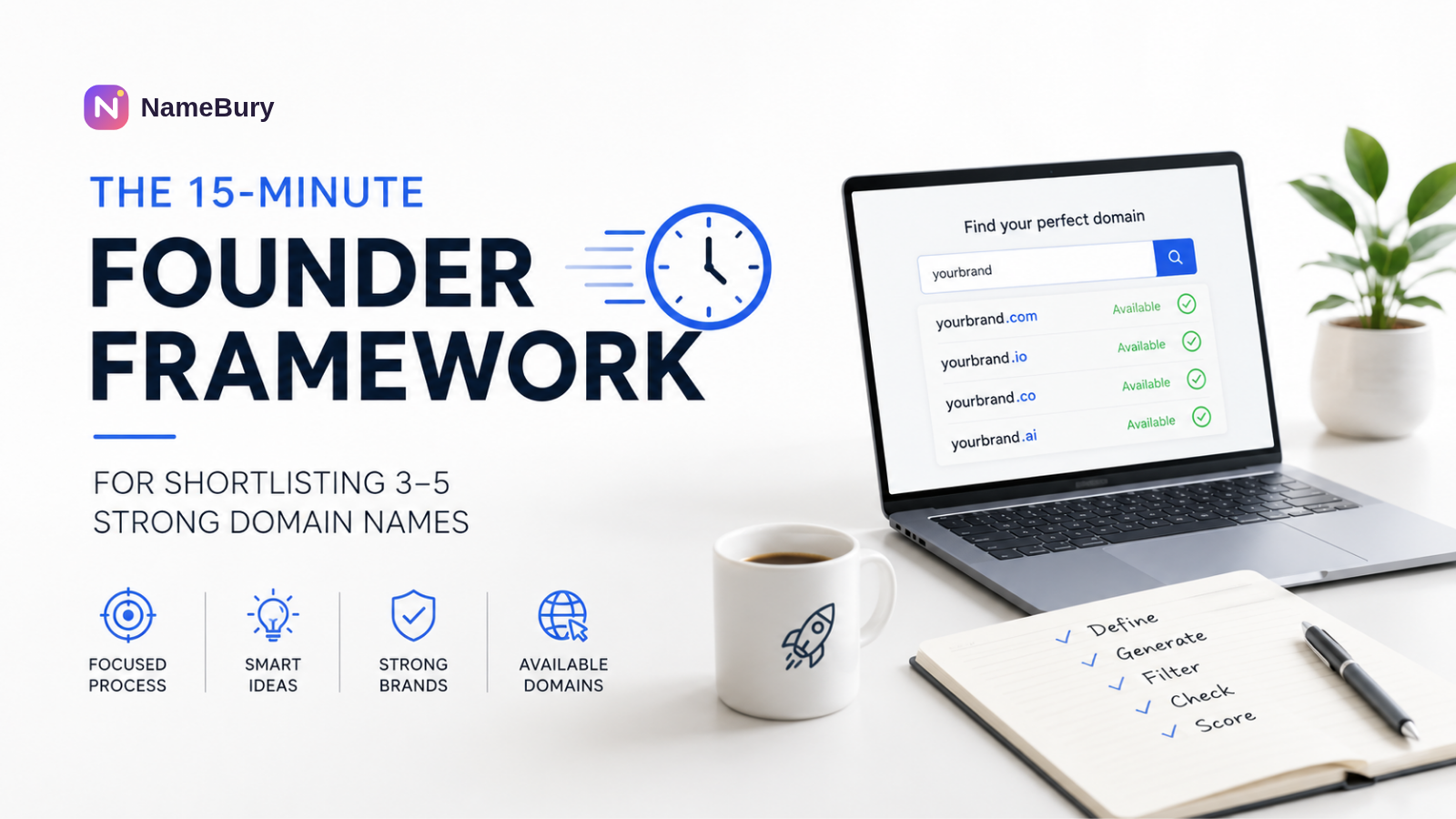
Domain searching has a way of swallowing entire afternoons. You start with one idea, check a few .coms, try a synonym, open ten tabs, second-guess your brand direction, and somehow end up two hours later with nothing but decision fatigue.
That happens because domain selection sits at the intersection of branding, positioning, memorability, and availability. Without a process, the search expands to fill all available time.
The good news: founders do not need a perfect domain on the first pass. They need a fast, credible shortlist.
This 15-minute framework is designed to help you move from a rough startup description to 3–5 strong domain candidates in one focused session. It is especially useful when you are stuck, overthinking, or trying to make progress quickly before launch.
Why domain searching expands to fill all available time
Domain hunting feels deceptively simple, but it becomes slow when there are no constraints. Founders often make three common mistakes:
- They search with only one naming direction. If that path is taken, everything stalls.
- They evaluate too many variables at once. Brand fit, SEO, pronunciation, legal risk, and availability all blur together.
- They chase perfection instead of momentum. The goal is not to find the only possible name. The goal is to identify several names that are good enough to move forward.
A shortlisting framework fixes this by turning domain search into a timed decision exercise rather than an open-ended creative loop.
Step 1: Define your startup’s category, target customer, and desired vibe
Before you brainstorm names, define the inputs. If you skip this step, you will generate random ideas that sound interesting but do not support your positioning.
Write down three things:
- Category: What kind of company are you building?
- Target customer: Who is it for?
- Desired vibe: What should the name feel like?
Keep each answer short. One line is enough.
Example:
- Category: AI scheduling assistant for sales teams
- Target customer: Startup sales reps and revenue teams
- Desired vibe: Fast, reliable, modern, professional
This gives your naming session direction. A domain for a fintech API should sound different from a wellness app for new parents. Clarity here saves time later.
If helpful, use a simple prompt format:
We help [target customer] solve [problem] with [type of product]. The brand should feel [3 adjectives].
Step 2: Set hard constraints: length, no hyphens, preferred TLDs
Constraints speed up creativity. They eliminate weak options before you waste time on them.
Set your domain rules up front:
- Length: Ideally 6–14 characters for the core name
- No hyphens: They reduce memorability and trust
- No unusual spellings unless clearly intentional: If people cannot spell it, they will not find it
- Preferred TLDs: Usually .com first, then strong alternatives like .io, .co, .ai, or an industry-relevant TLD
- Avoid numbers: They create confusion in spoken and typed use
For most startups, a simple rule works well: short, clean, pronounceable, and credible.
This is also where you decide whether you are open to non-.com options. If your exact .com is unavailable, you do not want to restart the entire process. Decide in advance which TLDs are acceptable for your stage, market, and audience.
Step 3: Generate multiple naming directions, not just one
This is where many founders get stuck. They pick one concept, such as “speed,” and then try fifty variations of the same root word. That narrows the search too early.
Instead, generate multiple naming directions. Aim for 4–6 distinct angles.
Common naming directions include:
- Descriptive: Suggests what the product does
- Benefit-driven: Focuses on the outcome
- Metaphorical: Uses imagery or analogy
- Invented or blended: Combines sounds or words into something new
- Trust-oriented: Signals reliability, security, or professionalism
- Category-adjacent: Uses language familiar to your market
Example for an AI scheduling startup:
- Descriptive: MeetFlow, SchedulePilot
- Benefit-driven: CloseFaster, TimeMint
- Metaphorical: RelayFox, NorthSlot
- Invented: Calivo, Schedora
- Trust-oriented: SignalDesk, Accordly
The goal is quantity across directions, not perfection within one direction. In a 15-minute session, you might generate 20–30 rough candidates, then quickly narrow them down.
If you use AI domain tools here, ask for batches by naming style rather than one giant undifferentiated list. That makes evaluation much faster.
Step 4: Filter for spelling, pronunciation, and trust
Now take your rough list and remove anything that creates friction.
A strong founder domain should pass three fast tests:
1. Spelling test
If someone hears the name once, can they type it correctly?
Reject names that depend on:
- Confusing letter swaps
- Silent letters
- Forced misspellings
- Ambiguous endings
2. Pronunciation test
If someone sees the name written down, can they say it out loud without hesitation?
This matters more than many founders expect. You will say your domain in calls, podcasts, demos, and intros. If it is awkward to pronounce, it creates drag.
3. Trust test
Does the name sound credible enough for the market you are serving?
Trust matters especially in B2B, fintech, health, legal, and infrastructure categories. A playful invented name might work for a consumer app but feel too lightweight for enterprise security software.
Ask yourself:
- Would I feel comfortable sending customers to this URL?
- Does this sound legitimate in a pitch deck or email signature?
- Does it match the level of seriousness my audience expects?
After this step, you should have a smaller set of names that are not just creative, but usable.
Step 5: Check availability and basic trademark risk
Only now should you begin checking live availability. Doing this too early slows everything down because you interrupt the naming process every few minutes.
For each remaining candidate, check:
- Domain availability: Start with your preferred TLDs
- Handle availability: Optional, but useful if social consistency matters
- Basic trademark risk: Search for obvious conflicts in your market
You do not need full legal analysis in this 15-minute sprint, but you do need to avoid obvious problems. If a similar name already exists in the same category, especially with overlapping customers, remove it from the shortlist.
A practical rule: if a candidate is available as a domain but clearly collides with an established brand, it is not a real option.
This step is about basic risk reduction, not final legal clearance. For a serious launch, consult trademark counsel before committing.
Step 6: Compare final candidates with a simple scoring matrix
At this point, you should have a handful of viable names. The fastest way to choose among them is a lightweight scoring matrix.
Score each candidate from 1 to 5 across these criteria:
- Brand fit: Does it match your positioning and vibe?
- Memorability: Is it easy to remember after one exposure?
- Clarity: Is it easy to spell and pronounce?
- Trust: Does it sound credible for your market?
- Availability: Is the domain realistically usable?
Example matrix:
NameBrand FitMemorabilityClarityTrustAvailabilityTotalMeetFlow4454320Accordly5445422Calivo3443519
This prevents emotional overattachment to one idea and helps you compare options quickly. You are not trying to prove one name is perfect. You are trying to identify the strongest 3–5 candidates worth considering further.
Your 15-minute founder workflow
If you want to run this as a real timed sprint, use this breakdown:
- 2 minutes: Define category, customer, and vibe
- 2 minutes: Set naming constraints and acceptable TLDs
- 4 minutes: Generate multiple naming directions and rough ideas
- 3 minutes: Filter for spelling, pronunciation, and trust
- 2 minutes: Check availability and obvious conflicts
- 2 minutes: Score finalists and shortlist 3–5 names
The key is to keep moving. This is a shortlisting session, not a final branding workshop.
How AI domain tools help founders repeat this process in minutes
AI domain tools are most useful when they support a structured process rather than replace judgment. They can dramatically reduce time to shortlist by helping with:
- Generating naming directions quickly
- Producing dozens of brandable variations
- Filtering out weak or awkward constructions
- Checking patterns across TLD options
- Repeating the process for new positioning angles
The advantage is not just speed. It is repeatability. If your first naming direction is too playful, too generic, or too narrow, you can rerun the same framework with a different vibe and get a fresh shortlist in minutes.
That matters for founders because naming often changes as positioning sharpens. A good process lets you iterate without losing a day every time.
Final takeaway
Strong domain shortlisting is not about endless searching. It is about making a series of fast, sensible decisions in the right order.
Define what your startup is. Set clear constraints. Explore multiple naming directions. Filter for usability and trust. Check availability. Then score what remains.
Do that in one focused 15-minute session, and you can go from “we still have no name” to a shortlist of 3–5 credible domain candidates that are ready for deeper review.
For founders, that is the real win: not finding the perfect domain instantly, but reducing time to shortlist so the company can keep moving.