
The 15-Minute Startup Naming Process: From Product Idea to Domain Shortlist
The 15-Minute Startup Naming Process for Founders
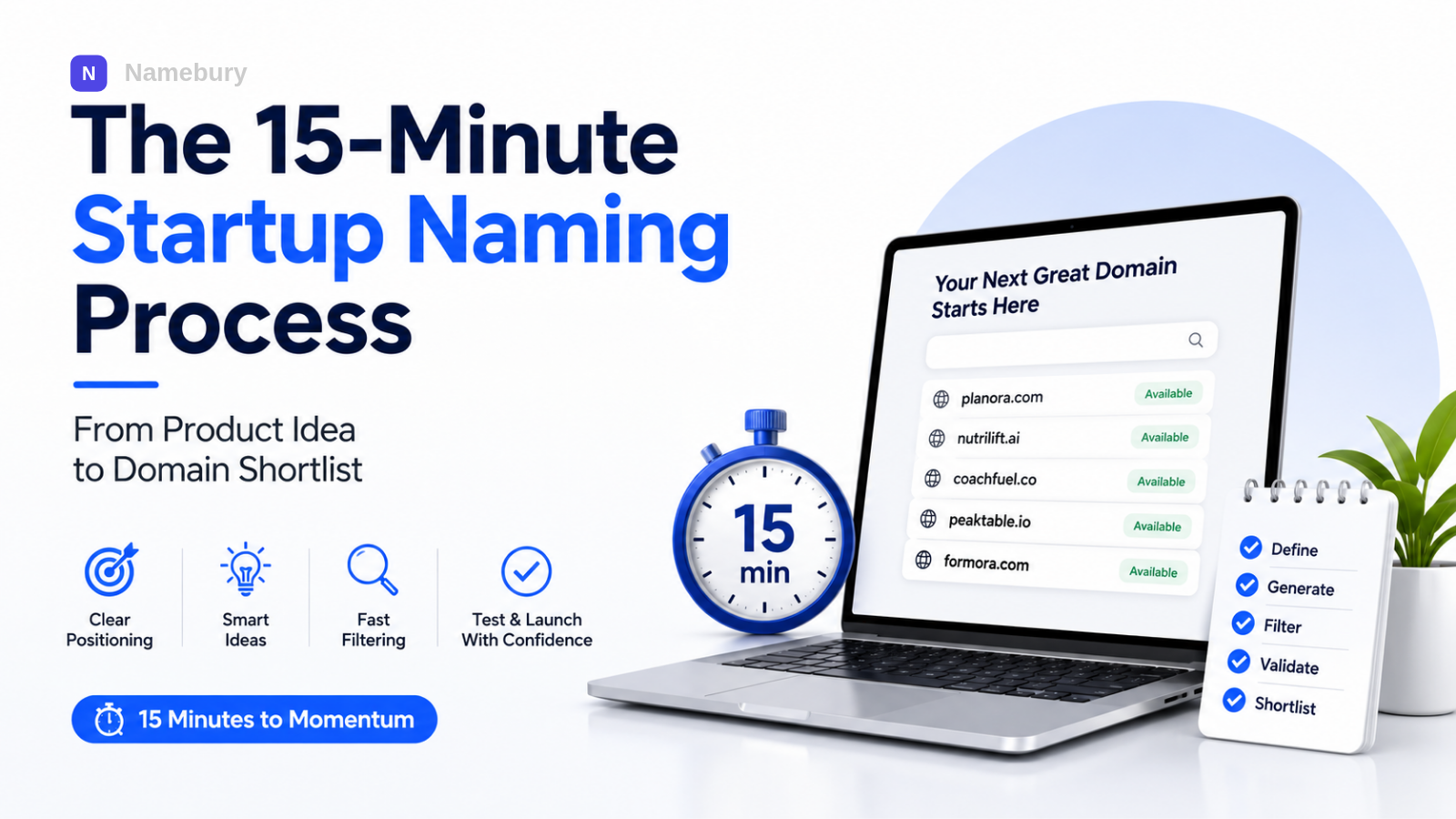
The 15-Minute Startup Naming Process: From Product Idea to Domain Shortlist
If you're building an MVP, testing demand, or trying to get a landing page live this week, naming your startup should not become a three-day detour. Yet for many first-time founders, it does. They open a registrar, type a few ideas, watch every decent domain get rejected, and suddenly naming feels like a bigger problem than validating the product.
It doesn't have to work that way.
A better approach is to treat naming like an early-stage startup task: fast, structured, and good enough to move forward. The goal is not to discover the perfect brand name in one sitting. The goal is to generate a strong shortlist of usable, credible, easy-to-test domains in about 15 minutes.
This framework is built for founders at pre-launch or MVP stage who need speed more than ceremony. If you can describe your product, your audience, your brand vibe, and your constraints, you can leave the session with 3–5 domain options worth testing.
Why founders get stuck on naming
Naming paralysis usually comes from trying to solve too many problems at once. Founders want a name that is original, short, brandable, available, memorable, credible, and emotionally resonant. That's a high bar, especially when you're also trying to validate a market, talk to users, and ship product.
The fix is simple: separate naming into timed decisions. First define what the startup does. Then define the rules. Then generate options by tone. Then filter quickly. Then test a shortlist.
This process is faster than manually checking registrar results one by one, and it gives you a repeatable system you can rerun whenever your positioning changes.
Minute 1–3: Define your startup category, audience, and promise
Before you generate any names, get clarity on three inputs:
- Category: What kind of startup is this?
- Audience: Who is it for?
- Promise: What outcome or value do you deliver?
Keep this short. One sentence is enough.
Template:
Your startup helps [audience] do [job to be done] through [product category or mechanism] so they can [core outcome].
Example:
Our startup helps independent fitness coaches create personalized meal plans through AI-powered software so they can serve more clients in less time.
This step matters because vague inputs create vague names. Clear positioning creates more relevant options. If your startup description is too broad, your name list will be too generic.
At this stage, also note your desired brand vibe. Do you want the name to feel:
- Modern and technical?
- Friendly and approachable?
- Premium and trustworthy?
- Bold and disruptive?
- Simple and utility-driven?
That tone will shape the type of names you generate later.
Minute 4–6: Pick your naming constraints
Constraints are what make the process fast. Without them, you can brainstorm forever. With them, you can reject weak options instantly.
Set your rules before you look at names:
- Length: Prefer 6–12 characters if possible
- Spelling: Easy to say and easy to type after hearing once
- Hyphens and numbers: Avoid them
- TLDs: Decide whether you want .com only, or if .co, .io, .ai, or .app are acceptable
- Keyword use: Decide whether you want descriptive, suggestive, or invented names
- Style: One word, compound word, blended word, or phrase
For most early-stage founders, the best default constraints are:
- Short
- No hyphens
- No numbers
- Easy to pronounce
- .com preferred, but flexible if the audience is startup-savvy
If speed matters most, don't make .com a rigid requirement unless your category truly demands it. Many founders waste hours chasing unavailable .com domains when a clean .co, .io, or .ai would work perfectly for early validation.
Write down your constraints in one line. For example:
Short name, easy spelling, no hyphens, modern but trustworthy tone, .com or .ai preferred.
Minute 7–10: Generate names by tone and positioning
Now you generate options in batches rather than one long random brainstorm. This is where founders save the most time by using an AI domain generator instead of starting with a registrar search box.
Why? Because a registrar only tells you whether a specific name is taken. It does not help you think. An AI naming workflow helps you create relevant options based on your startup description, target customer, vibe, and constraints.
The easiest way to do this is to generate names across a few tone categories:
1. Descriptive names
These make the category obvious. They're useful when clarity matters more than brand mystery.
Examples: PlanPilot, CoachMeal, ClientFuel
2. Suggestive names
These hint at the benefit or transformation without describing the product literally.
Examples: NutriLift, PeakTable, Formora
3. Invented or blended names
These are often more brandable and more likely to have available domains, especially in crowded categories.
Examples: Mealivo, Trainora, Planyx
4. Trust-oriented names
These work well in categories where credibility matters, such as fintech, health, legal, or B2B software.
Examples: Surepath, Validesk, TrueMetric
5. Modern startup-style names
These are punchy, flexible, and often designed for memorability.
Examples: Vanta-style, Notion-style, Linear-style inspired names without copying them directly
Generate 20–30 names quickly, then sort them into three buckets:
- Clear: easy to understand
- Brandable: distinct and memorable
- Flexible: broad enough to grow with the company
At this point, don't overanalyze. Your job is to create options, not to make the final decision yet.
Helpful prompt structure:
Generate startup name ideas for a company that helps [audience] do [outcome]. The brand should feel [tone]. Keep names short, easy to spell, and suitable for [.com/.ai/.io]. Avoid hyphens, numbers, and overly generic words. Provide descriptive, suggestive, and invented options.
Minute 11–12: Filter by availability and ease of spelling
Once you have a candidate list, start cutting aggressively.
Check each option against these fast filters:
- Can someone spell it after hearing it once?
- Can someone pronounce it without explanation?
- Does it look clean in a URL?
- Is the domain available in one of your acceptable TLDs?
- Does it avoid awkward letter combinations or confusion?
Delete names that fail any of these checks. Founders often keep clever names that create friction. That's a mistake. In the MVP stage, usability beats cleverness.
For example, if a name requires you to explain whether it's spelled with an "i," a "y," or a double consonant, it's already costing you trust and attention.
This is where an AI domain generator becomes especially practical. Instead of jumping between brainstorming and registrar tabs, you move directly from generated ideas to availability-aware shortlisting.
Minute 13–14: Run a quick credibility and memorability check
Now take your remaining names and pressure-test them with two questions:
Credibility check
Ask yourself:
- Would this name look legitimate on a landing page?
- Would I feel comfortable sending this domain to a prospect, mentor, or investor?
- Does it fit the expectations of my market?
A playful invented name might work for a consumer app, but it may not fit a compliance tool for finance teams. The right name depends on context.
Memorability check
Ask yourself:
- Can I remember it five minutes later?
- Could a user repeat it correctly after hearing it once?
- Does it sound too similar to other startup names?
A simple test: close the tab, wait a minute, and try to write down your top three from memory. The names you recall most easily are often the strongest candidates.
You can also do a quick spoken test. Say each name out loud in a sentence:
- "Visit us at ____."
- "I built ____ for freelance designers."
- "We're launching ____ next month."
If it sounds awkward, forced, or forgettable, cut it.
Minute 15: Choose 3–5 domains to test
By the end of the process, your goal is not one final forever name. Your goal is a shortlist.
Pick 3–5 domains that meet these criteria:
- Relevant to your product and audience
- Easy to spell and say
- Available in an acceptable TLD
- Credible for your market
- Memorable enough to test
Then share them with a small group of trusted people:
- Mentors
- Potential users
- Co-founders
- Early advisors
Ask simple questions, not open-ended ones:
- Which one sounds most trustworthy?
- Which one is easiest to remember?
- Which one best fits this product idea?
- Which one would you be most likely to click?
Keep the feedback tight. You're looking for directional confidence, not committee-driven branding.
Why this process works better than manual registrar searching
Manual registrar searching feels productive, but it's usually inefficient. You type a name, see it's taken, try another, get distracted, lower your standards, and eventually settle for something random or clunky. The process is reactive.
This framework is proactive. It starts with positioning, applies constraints, generates names by category, and only then checks availability. That sequence matters.
Here is why it works better:
- It reduces decision fatigue: You make smaller, faster choices instead of one giant branding decision.
- It improves relevance: Names are tied to your audience and promise, not just domain luck.
- It avoids rabbit holes: Time-boxing keeps you moving.
- It is repeatable: If your positioning changes, you can rerun the same workflow in minutes.
- It gets you to testing faster: You leave with a shortlist, not a headache.
How AI helps founders move from naming paralysis to launch confidence
For early-stage founders, AI is most useful when it removes friction from high-uncertainty tasks. Startup naming is one of those tasks.
An AI domain generator is not valuable because it feels futuristic. It's valuable because it compresses hours of brainstorming, filtering, and searching into a practical workflow. You enter your startup description, target customer, brand vibe, and constraints. You review options. You rerun with tweaks. You leave with names worth testing.
That is the real benefit: momentum.
Instead of waiting for inspiration, you get a system. Instead of manually searching registrars for every half-formed idea, you generate aligned options at scale. Instead of getting stuck between "good enough" and "perfect," you move forward with confidence.
At the MVP stage, speed matters. The name just needs to be strong enough to support validation, outreach, and early trust. You can refine later if needed. What matters now is getting from product idea to live test as quickly as possible.
A simple 15-minute naming checklist
- Define your category, audience, and promise
- Choose your brand tone
- Set constraints: short, no hyphens, acceptable TLDs
- Generate names across descriptive, suggestive, and invented styles
- Filter for spelling, pronunciation, and availability
- Check credibility and memorability
- Select 3–5 domains to test
If you can do that in 15 minutes, you've already beaten the slow, frustrating naming process that traps so many founders before launch.
The best startup name is not the one you brainstorm forever. It's the one that helps you ship, test, and learn faster.