
The Low-Stress Way to Compare 3 Brand Names Before You Commit
How to Compare 3 Brand Names Before You Commit
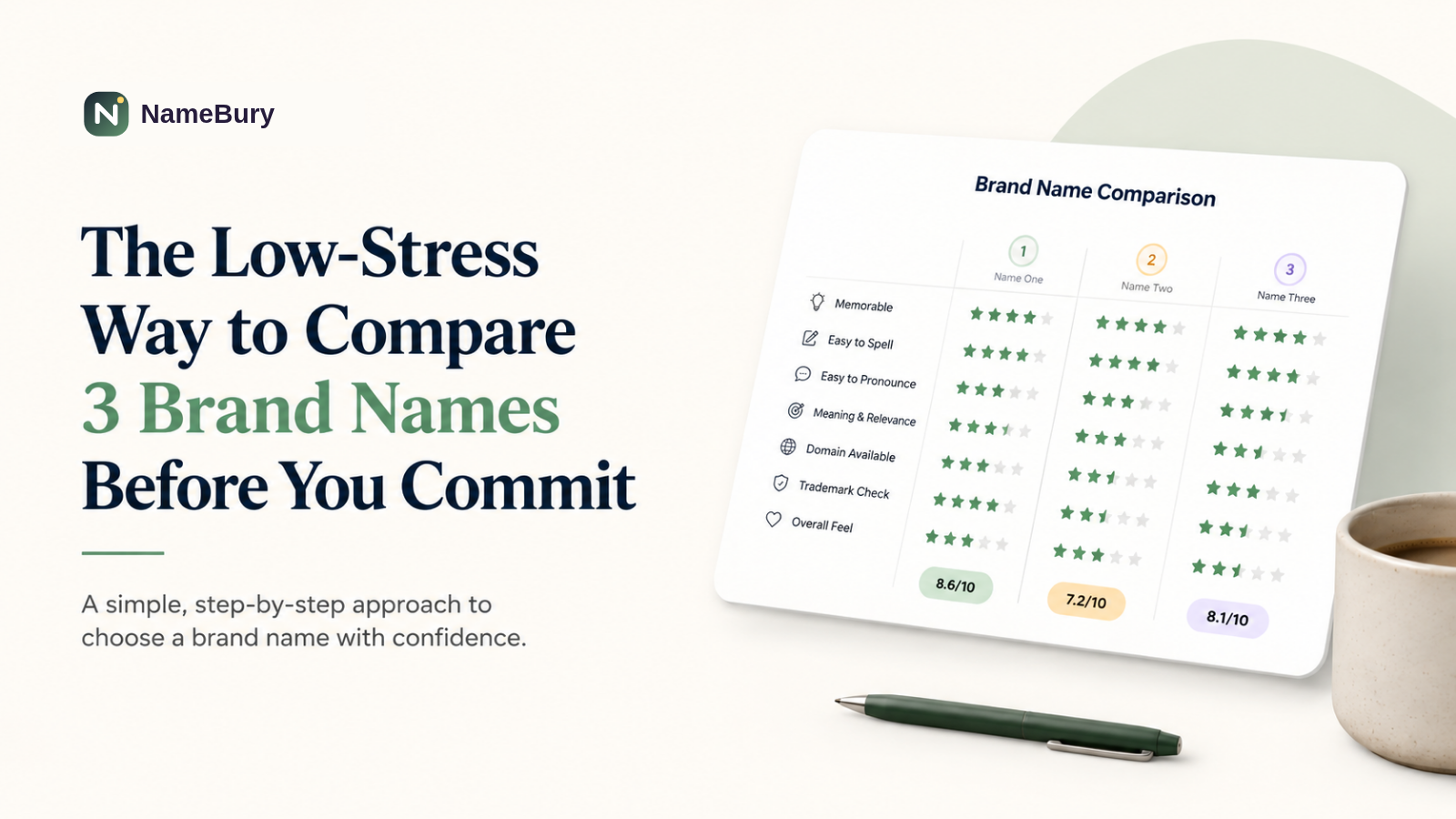
Choosing a brand name can feel bigger than it needs to be. For many founders, the hardest part is not generating ideas—it’s getting stuck between a few decent options and endlessly circling them.
If that’s where you are, here’s the good news: you do not need a perfect naming process. You need a simple, repeatable way to compare your top three names using the same criteria.
This article walks you through a low-stress shortlist method for indecisive founders. The goal is straightforward: evaluate each option side by side, eliminate names with obvious conflict signals, and choose the strongest candidate without spinning for another two weeks.
Why comparing three names works better than chasing the perfect one
Once you have more than a handful of ideas, naming usually stops being creative and starts becoming noisy. Every option begins to sound either brilliant or terrible depending on the hour.
A shortlist of three names is useful because it forces focus. It gives you enough contrast to compare style and practicality, but not so many options that you end up in analysis paralysis.
Your job at this stage is not to find a magical name that wins every category. Your job is to identify the option that is:
- clear enough for your audience to understand
- memorable enough to repeat
- available enough to use consistently
- clean enough to avoid obvious legal or market conflicts
That is a much more realistic standard—and a much better way to make progress.
The 3-name comparison framework
Take your three finalists and score each one using the same checklist. Keep it simple. A 1–5 scale works well for most founders.
Evaluate each name across these categories:
- Vibe: Does the name match your brand personality and audience expectations?
- Clarity: Is it reasonably easy to understand, pronounce, and spell?
- Memorability: Is it distinctive enough to stick in someone’s mind after hearing it once?
- Domain fit: Can you get a usable domain without awkward compromises?
- Handle consistency: Are social usernames reasonably aligned across platforms?
- Trademark signals: Are there obvious conflicts that make the name risky?
The key is consistency. Do not give one name a deep legal review and another a quick Google search. Run the same search steps for all three.
Step 1: Score the vibe
Start with the emotional and strategic fit. A strong brand name does not just sound good in isolation—it feels right for what you sell and who you serve.
Ask:
- Does this sound premium, playful, technical, trustworthy, bold, or calm in the way you want?
- Would your target customer feel like this brand is “for them”?
- Does the name fit your category while still standing apart?
- Can it grow with your business if you expand later?
For example, a consultancy may need a different naming tone than a skincare brand or a creator tool. A name can be clever and still be the wrong emotional match.
Scoring tip: If you have to explain why the vibe works, it may not work as well as you think. The best-fit names usually feel aligned quickly.
Step 2: Score clarity and memorability
These two categories deserve separate scores because they solve different problems.
Clarity
Clarity is about friction. If people hear the name once, can they say it back, spell it, and search for it without help?
Ask:
- Is it easy to pronounce?
- Is the spelling intuitive?
- Could someone mishear it as another common word or brand?
- Does it create confusion about what the business is?
A name does not need to be literal, but if it creates too much friction, you will pay for that later in word-of-mouth, search, and referrals.
Memorability
Memorability is about stickiness. A memorable name is easier to recall, recommend, and revisit.
Ask:
- Does it sound distinctive from competitors?
- Does it create a strong mental image or rhythm?
- Would someone remember it after hearing it once in conversation?
- Is it interesting without being hard to use?
Some names are very clear but instantly forgettable. Others are memorable but too awkward to spell. You want the best balance, not the most extreme score in one category.
Step 3: Compare domain fit
This is where many naming decisions become practical fast. You do not necessarily need the exact .com to build a good business—but you do need a domain that feels credible, usable, and easy to share.
Check each name using the same domain criteria:
- Is the exact-match .com available?
- If not, is there a clean alternative such as a short modifier?
- Does the available domain look trustworthy, or does it feel forced?
- Does it introduce hyphens, extra words, or odd spellings you will have to explain repeatedly?
Examples of workable alternatives might include adding a relevant word like studio, labs, hq, or get—but only if the result still feels natural.
Good domain fit: short, readable, easy to say aloud, and close to the brand name.
Poor domain fit: long, cluttered, or dependent on constant explanation.
If one name requires a messy domain while another gives you a clean, intuitive URL, that matters.
Step 4: Check social handle consistency
Next, compare how easily you can use the name across major social platforms. You do not need every exact handle on every network, especially if social is not central to your growth model. But consistency helps people find and trust you.
Search the main platforms relevant to your brand and look for:
- exact-match handle availability
- close-match handle availability
- inactive accounts using the name
- accounts in the same category using something very similar
Your goal is not perfection. Your goal is consistency without confusion.
For example, if your brand name is available as:
- @northvale on one platform
- @northvalehq on another
- @northvale.co on a third
that may still be workable. But if the clean versions are taken by active businesses in related industries, the name becomes less attractive.
Rule of thumb: Small variations are manageable. Ongoing confusion is not.
Step 5: Run a basic trademark screening for each name
This is not a substitute for legal advice, but it is a smart first-pass filter. The purpose of a basic trademark screen is to eliminate names with obvious red flags before you get emotionally attached.
Run the same basic search steps for each of your three options:
- Search Google for the exact name, close variations, and the name plus your product or service category.
- Check business directories and app stores if relevant to your industry.
- Search the trademark database in the countries where you plan to operate, especially for similar names in related classes.
- Look for category overlap—not just exact matches, but similar names used for similar offers.
- Note obvious conflict signals such as an established brand with similar spelling, pronunciation, or commercial space.
You are not trying to become your own trademark attorney. You are trying to spot the names that are clearly too risky to keep on the board.
Obvious conflict signals to take seriously
- A registered mark in your market for similar goods or services
- A well-known brand with similar pronunciation or spelling
- Multiple existing businesses in your category using near-identical wording
- A name that would likely cause customer confusion
If one of your three names throws up repeated conflict signals, do not rationalize it away just because it is your favorite. Eliminate it and move on.
A simple side-by-side scorecard
Here is a practical scorecard you can copy into a doc or spreadsheet:
CriteriaName AName BName CVibe fit/5/5/5Clarity/5/5/5Memorability/5/5/5Domain fit/5/5/5Handle consistency/5/5/5Trademark signals/5/5/5Total/30/30/30
Use the notes column too. Numbers help, but comments explain the real decision.
For example:
- Name A: Great vibe, weak domain
- Name B: Clear and available, but forgettable
- Name C: Memorable and strong domain, but possible trademark concern
Often the winner becomes obvious once you see tradeoffs in one place.
How to break a close tie
If two names score similarly, use these tie-breakers:
- Choose the name with fewer friction points. Less explanation usually wins over more cleverness.
- Choose the name with cleaner availability. Better domain and handle consistency compounds over time.
- Choose the safer name legally. A slightly less exciting name is better than a future rebrand.
- Choose the one your audience will repeat most easily. Word-of-mouth matters.
Founders often overvalue originality and undervalue usability. In practice, the easier name usually performs better than the more “interesting” one.
What not to do during the comparison process
- Do not crowdsource the decision to everyone you know. Random opinions create noise, not clarity.
- Do not keep changing the criteria. Use the same framework for each option.
- Do not ignore obvious conflict signals. Hope is not a naming strategy.
- Do not wait for total certainty. A strong, usable choice beats endless hesitation.
If you want feedback, get it from a small group of people who resemble your actual audience or understand your market.
The goal is not perfection. It’s commitment.
A good brand name earns its value through use. It becomes meaningful because you build trust, visibility, and associations around it. That means your decision does matter—but not in the mythical way founders sometimes imagine.
You do not need the one perfect name hidden somewhere in a spreadsheet. You need a name that clears the practical bar, fits your brand, and lets you move.
So if you are stuck between three options, stop trying to feel your way into certainty. Compare them side by side. Score clarity and memorability. Run the same search steps for each. Check domain and handle consistency. Eliminate the names with obvious conflict signals.
Then choose the strongest option and commit.
That is the low-stress way to name a brand.