
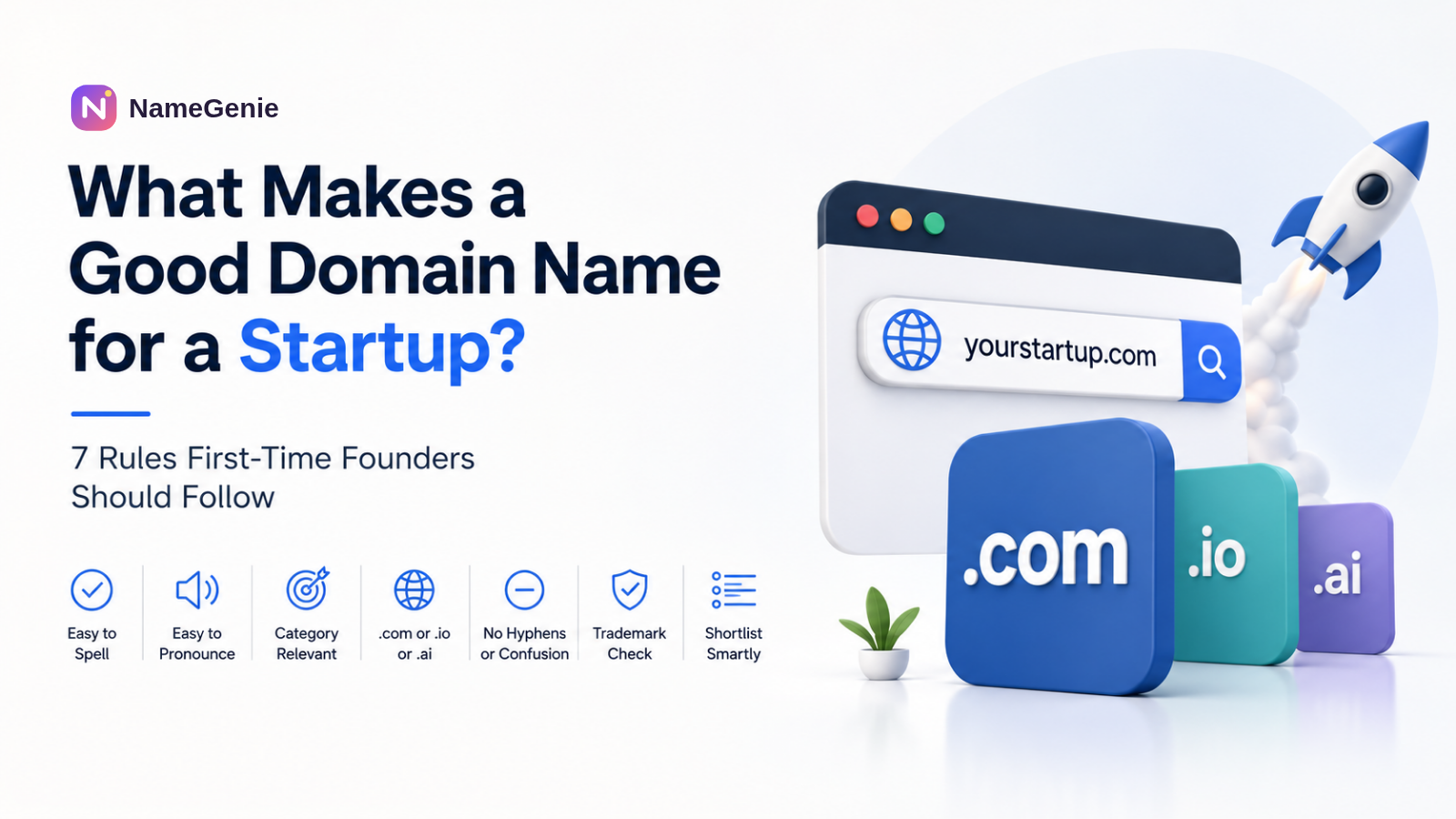
What Makes a Good Domain Name for a Startup? 7 Rules First-Time Founders Should Follow
What Makes a Good Domain Name for a Startup? 7 Rules
For pre-launch founders, a domain name is not a small branding detail you can clean up later. It shows up in your pitch deck, email address, demo link, landing page, and first customer conversations. Before you have traction, your domain often stands in for credibility.
That is why choosing a good startup domain should be practical, not precious. You do not need a mythical perfect name. You need a name that is clear, trustworthy, easy to use, and available enough to help you launch.
If you are building an early-stage B2B SaaS product or a tool-enabled startup, this checklist will help you evaluate domain ideas quickly and avoid wasting time on names that sound clever but fail in real use.
Why your domain matters before launch
Early on, your domain does three important jobs:
- Credibility: A clean, professional domain makes your startup look more real to prospects, investors, and early hires.
- Memorability: If someone hears your company name once on a call, they should be able to find you later without guessing.
- Pitch readiness: You need a domain that works in intros, demos, waitlists, and outbound emails right away.
A weak domain creates friction at exactly the wrong moment. People misspell it, misremember it, hesitate to click it, or confuse it with something else. A strong one removes those small trust leaks before they slow you down.
Rule 1: Make it easy to spell after hearing it once
This is one of the best tests for a startup domain: if you say it aloud in a meeting, can the other person type it correctly without help?
If the answer is no, the name will cost you attention. Every extra clarification adds friction:
- “It is spelled with a y, not an i.”
- “There is no e at the end.”
- “It is two words combined.”
- “Use the plural version.”
Founders often overvalue originality and undervalue usability. A domain that sounds distinctive but is constantly misspelled becomes a recurring problem across word-of-mouth, podcasts, sales calls, and referrals.
Checklist:
- Avoid intentional misspellings unless they are extremely intuitive.
- Avoid uncommon letter swaps like x for ks or z for s.
- Avoid names that require explanation every time you say them.
- Test the name by saying it once to a friend and asking them to type it.
If they get it wrong, treat that as data, not bad luck.
Rule 2: Choose a name people can pronounce confidently
A good domain should not make prospects pause when they try to say it out loud. Pronunciation matters because startup names travel through conversations before they travel through search.
Think about all the moments when someone might say your company name:
- introducing you to a colleague
- mentioning your product in a team meeting
- recommending your tool on a podcast
- bringing up your startup in an investor conversation
If people are unsure how to pronounce the name, they are less likely to repeat it. That hurts memorability and word-of-mouth growth.
What to look for:
- Simple syllables
- Familiar word structures
- No ambiguity about where emphasis goes
- No weird blends that can be read multiple ways
You do not need a boring name. You need one people can say confidently without asking, “Am I pronouncing this right?”
Rule 3: Signal your product category without sounding generic
The best startup domains often create a balance between clarity and distinctiveness. They give some hint about what the company does, but they do not sound like a placeholder brand.
For early-stage B2B SaaS and tool-enabled startups, category signaling matters because you do not have brand recognition yet. A name that loosely suggests automation, analytics, workflows, security, infrastructure, or collaboration can help people place you faster.
But there is a line. If your domain is too generic, it becomes forgettable and harder to defend.
Examples of weak generic patterns:
- BestWorkflowTools.com
- CloudDataPlatform.io
- SecureAutomationApp.ai
These may describe a category, but they do not feel like credible brands.
A better approach: combine a clean, brandable root with a subtle category cue. That might come from a familiar concept, a metaphor, or a relevant suffix. The goal is to help people think, “I get roughly what this is,” without making the name sound interchangeable with ten competitors.
Rule 4: Check .com plus one strong alternative TLD like .io or .ai
For many startups, .com is still the strongest default because it signals legitimacy and is what people instinctively type first. If the .com is available at a reasonable price, it is often the simplest choice.
But first-time founders should not burn days trying to force a bad .com just because it is a .com. If your ideal name is unavailable, checking one strong alternative TLD can be a smart move, especially in startup categories where certain endings are already familiar.
Common options:
- .com for broad trust and default credibility
- .io for software, developer tools, and SaaS
- .ai for AI-native products and machine-learning startups
The key is discipline. Do not scatter across five weak TLDs. Check .com first, then evaluate one strong alternative that fits your market.
Questions to ask:
- Will customers naturally assume the .com version instead?
- Does this TLD feel normal in our category?
- Will this domain look credible in outreach emails and investor materials?
If the answer is yes, an alternative TLD can be a practical launch decision.
Rule 5: Avoid hyphens, awkward abbreviations, and confusing word mashups
Many weak startup domains share the same problem: they were created to solve availability, not usability.
That is how founders end up with names that include:
- hyphens
- forced abbreviations
- missing vowels
- stacked nouns
- unclear mashups of two words
These usually create more confusion than value. They are harder to say, harder to type, and easier to misremember.
Watch out for:
- Hyphens: They look less polished and are easy to forget.
- Awkward abbreviations: If only you understand what the letters mean, the market will not.
- Word mashups: If people cannot tell where one word ends and the next begins, the name becomes fragile.
A domain should reduce cognitive load, not increase it. If a name feels like a workaround, it probably reads like one too.
Rule 6: Do a basic trademark and search check before getting attached
Founders often make the same mistake: they brainstorm for hours, fall in love with a name, design a logo, and only then discover that the term is already in use by another company in a similar space.
You do not need to run a full legal process before shortlisting ideas, but you should do a basic screening early.
At minimum, check:
- search engine results for the exact name
- existing companies in your category using similar names
- basic trademark databases in your main market
- social handle availability if that matters for your go-to-market
This step is not about becoming a lawyer. It is about avoiding obvious collisions before you invest energy in a name that may be unusable.
If a term is heavily associated with another software company, especially in a related category, move on quickly. Naming momentum is useful, but attachment is expensive.
Rule 7: Shortlist 3–5 options instead of obsessing over one perfect name
One of the fastest ways to get stuck is to search for a single perfect domain and refuse to consider alternatives. In practice, strong founders usually move faster when they build a shortlist of viable options and compare them against clear criteria.
A useful shortlist should include 3 to 5 names that all pass the basics:
- easy to spell
- easy to pronounce
- credible-looking
- category-relevant
- available on a usable TLD
- unlikely to create obvious legal conflict
Then rank them based on real-world use, not personal attachment. Ask:
- Which one would I feel comfortable saying on a sales call?
- Which one looks strongest in an email address?
- Which one is easiest to remember after a quick demo?
- Which one creates the least confusion?
This approach keeps you moving. At pre-launch, speed and clarity matter more than naming perfection.
How an AI-powered customizable domain generator speeds up this process
Domain brainstorming gets slow when every idea has to be invented, checked, filtered, and compared manually. That is where an AI-powered customizable domain generator can help.
Instead of producing random brand names, a useful generator can help founders explore options based on the criteria that actually matter:
- desired tone and style
- product category cues
- length preferences
- TLD priorities
- clarity and pronounceability
This makes it easier to generate a practical shortlist fast, especially when you want names that feel credible for B2B SaaS, AI tools, workflow products, or technical platforms.
The best workflow is simple:
- Define your naming constraints.
- Generate a broad set of options.
- Filter for spelling, pronunciation, and trust.
- Check domain availability and basic conflicts.
- Shortlist the strongest 3 to 5 and decide.
That process is much better than endlessly refreshing domain registrars and forcing weak combinations.
Final takeaway
A good startup domain is not just available. It is usable. It should be easy to spell after hearing it once, easy to pronounce, relevant enough to your category, and credible enough to support your launch.
If you follow these seven rules, you will avoid most of the naming traps that slow down first-time founders. And if you use an AI-powered customizable domain generator to create and refine options, you can get to a strong shortlist much faster.
Your goal is not to find the perfect name for the next ten years in one sitting. Your goal is to choose a domain that helps you launch with confidence now.