
Why Most Startup Domain Ideas Sound Generic—and How to Generate Brandable Alternatives
Why Startup Domain Ideas Sound Generic—and Better Naming Prompts
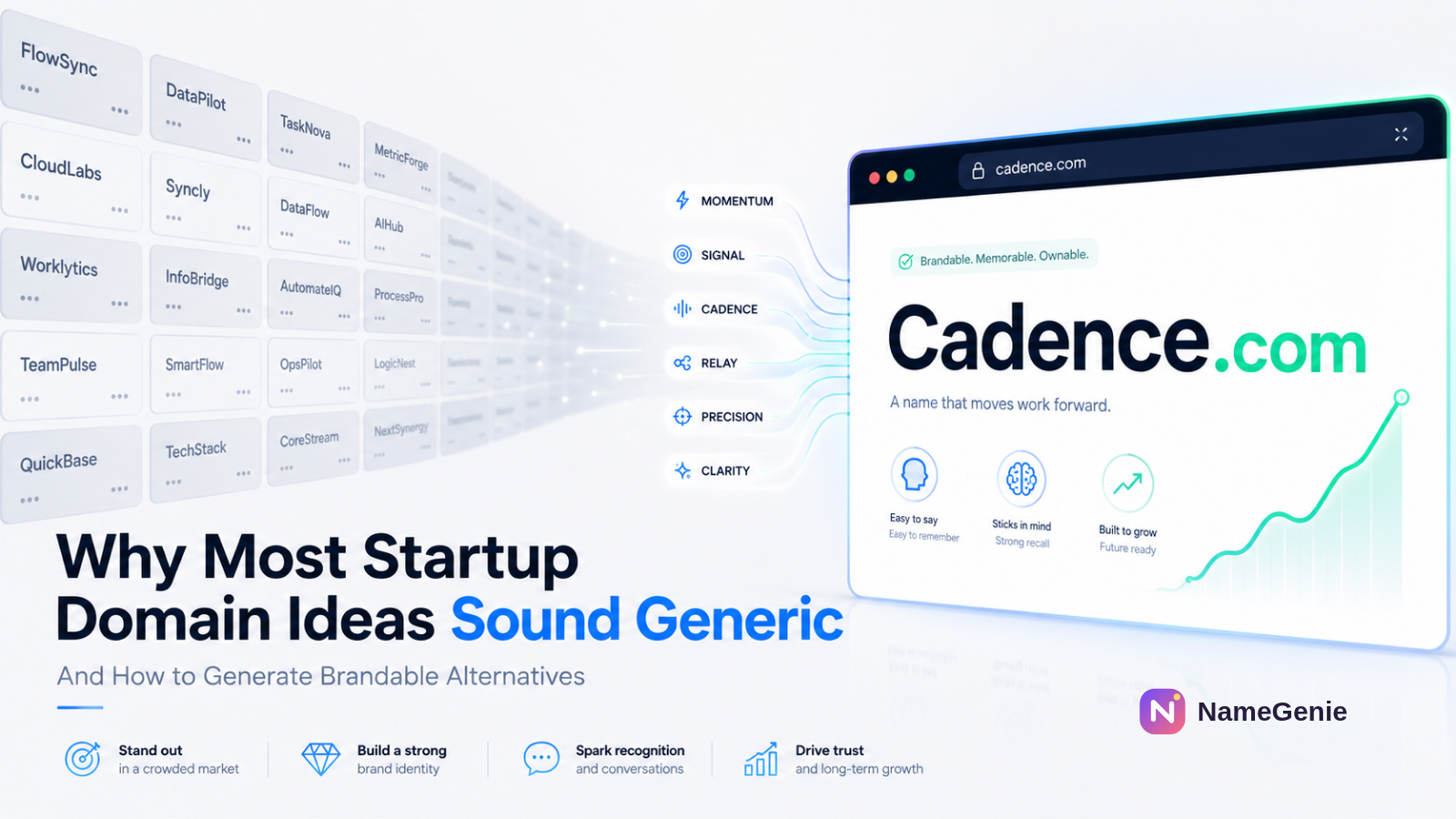
One of the fastest ways to kill momentum in a startup is to fall in love with a product idea and then get stuck on naming. Founders try a few brainstorming sessions, open an AI naming tool, and get back a list that feels painfully familiar: FlowSync, DataPilot, TaskNova, MetricForge. Nothing is technically wrong with these names. They’re just forgettable.
That’s the real frustration. Most founders aren’t rejecting AI-generated names because the tools are useless. They’re rejecting them because the output often sounds like every other SaaS company launched in the last five years.
If you’ve had that reaction, the problem usually isn’t that AI “can’t name things.” It’s that generic prompts produce generic naming patterns. The good news: brandable domain name ideas are not random magic. They follow recognizable principles, and you can generate much stronger options once you understand the trap.
The generic-name trap: why founders keep landing on forgettable domains
Most startup names become generic for a simple reason: founders optimize too early for clarity and category fit. They want the name to instantly explain the product, signal the niche, and sound credible. So they combine obvious industry words like flow, sync, data, cloud, labs, metrics, or AI.
The result is usually a name that is:
- Descriptive but not distinctive
- Easy to understand but hard to remember
- Relevant to the category but weak as a brand
This happens even more often with AI tools because founders tend to prompt them with inputs like: “Generate 50 startup names for an AI workflow automation platform.” That request practically invites the model to remix the same overused vocabulary found across thousands of existing companies.
In other words, the output feels generic because the instructions are generic.
And there’s a second problem: founders often judge names only by whether they “make sense” immediately. But strong startup names rarely win because they are the most literal option. They win because they create a distinct mental shape.
Common patterns that make startup names feel overused
If a domain idea feels like it came from a startup name generator, it usually follows one of a few predictable formulas.
1. Category word + functional word
Examples: DataBridge, FlowStack, TaskPulse
These names are common because they’re easy to generate. They also blur together instantly.
2. Trendy suffixes and prefixes
Examples: -ly, -io, -ify, -labs, -hub, -base
These can work occasionally, but when used mechanically they feel manufactured rather than memorable.
3. Abstract tech words with no personality
Examples: Nexora, Zentiq, Veltrix
These may look “startup-ish,” but many are empty shells: invented, polished, and instantly forgettable.
4. Direct keyword stuffing
Examples: BestWorkflowAI.com, CustomerInsightTool.com
These may help explain the product, but they rarely build a brand people want to talk about.
5. Safe names designed not to offend anyone
This is more subtle. Some names feel generic because they were built to sound professional, broad, and harmless. The result is often a name with no edge, no tone, and no emotional signal.
When every naming decision is filtered through “Would this sound normal to investors?” you often end up with something no one remembers a week later.
What brandable domain name ideas actually have in common
Brandable names are often misunderstood. Founders think a brandable name has to be abstract, strange, or completely disconnected from the product. That’s not true.
Strong brandable domain ideas usually share a few traits:
- They are distinctive in sound or structure
- They create a feeling, not just a description
- They fit the company’s positioning and audience
- They are easy enough to say, spell, and remember
- They leave room for the company to grow
A good brandable name doesn’t need to explain everything. It needs to feel like it belongs to a specific kind of company.
For example, a workflow automation startup aimed at enterprise ops teams may need a name that feels precise, calm, and dependable. A developer integration tool may benefit from something sharper, more technical, or more modular. A product for creative teams may need more energy and playfulness.
The point is not to be weird. The point is to be specific in identity.
How tone changes naming: serious, enterprise, playful, technical
One reason AI naming outputs disappoint founders is that the requested tone is often vague or missing. But naming is highly sensitive to tone. The same product category can produce very different names depending on the signal you want to send.
Serious
Serious names tend to feel stable, restrained, and credible. They avoid gimmicks and often use cleaner phonetics.
Useful for: fintech, infrastructure, compliance, enterprise software
Example direction: names that feel structured, minimal, and confident rather than flashy
Enterprise
Enterprise naming often overlaps with serious naming, but it usually emphasizes trust, scale, control, and operational clarity.
Useful for: B2B platforms selling into larger organizations
Example direction: names that sound durable and strategic, not trendy
Playful
Playful names use more energy, surprise, rhythm, or metaphor. They are often easier to remember but need to be handled carefully if the category demands credibility.
Useful for: SMB tools, creator products, team collaboration, consumer-adjacent SaaS
Example direction: names with motion, personality, or lightness
Technical
Technical names often feel sharper, more compact, and more system-oriented. They may hint at architecture, speed, precision, or engineering depth.
Useful for: APIs, developer tools, integrations, infrastructure products
Example direction: names with clean edges and a more utilitarian feel
Before generating names, decide what emotional register the name should occupy. Without that, you’re asking for “a startup name,” which is exactly how you get generic startup-name output.
Examples of stronger naming directions for workflow, insights, and integration products
Let’s look at how naming direction changes the quality of ideas. The goal here is not to hand you final names, but to show how a stronger brief creates stronger options.
Workflow product
Weak direction: names built from words like flow, task, automate, sync
Why they fail: they describe the category but sound interchangeable
Stronger direction: focus on concepts like momentum, orchestration, routing, cadence, handoff, sequence, or control
That shift tends to produce names with more shape and positioning. Instead of sounding like another automation app, the brand can sound like a system for keeping work moving reliably.
Insights product
Weak direction: names built from data, metrics, analytics, intelligence
Why they fail: they’ve been used to exhaustion and rarely create a memorable image
Stronger direction: focus on concepts like signal, lens, pattern, clarity, surface, trace, pulse, or reveal
This creates naming territory that feels more perceptive and less commodity-like.
Integration product
Weak direction: names built from connect, bridge, sync, link, unify
Why they fail: they’re accurate but overused to the point of invisibility
Stronger direction: focus on concepts like relay, mesh, layer, conduit, thread, port, channel, or exchange
These directions can make the product feel more architectural, technical, or infrastructure-grade rather than generic middleware.
The key lesson: don’t prompt around the obvious category labels. Prompt around the product’s deeper function, feeling, and role.
How to use constraints to get better AI-generated results
Founders often assume creativity comes from openness. In naming, the opposite is usually true. Better constraints create better names.
When using AI to generate startup domains, add constraints like:
- Tone: serious, elegant, bold, technical, playful
- Length: 4–8 letters, 2 syllables, or under 10 characters
- Structure: real-word adjacent, coined, compound, metaphorical, clean consonant-vowel patterns
- Avoid list: exclude words like AI, data, flow, sync, labs, cloud, metrics
- Audience: CIOs, product teams, developers, operations leaders, founders
- Positioning: premium, infrastructure-grade, modern, human, trustworthy
- Naming territory: movement, clarity, systems, precision, signal, momentum
These constraints force the model away from lazy patterns. They also help you evaluate names against strategy instead of reacting only on instinct.
Another useful technique is to ask for directions before asking for names. For example:
Give me 10 naming territories for a B2B workflow platform used by operations teams. The product helps teams route approvals, reduce bottlenecks, and maintain process reliability. Avoid generic SaaS words. Focus on serious, brandable territory.
Once you have the territories, ask the model to generate names from the strongest one or two. This two-step process usually produces much better results than asking for names immediately.
A repeatable prompt formula for better domain options
If you want better AI-generated startup names, use a prompt that includes category, audience, positioning, tone, naming territory, and exclusions.
Here’s a practical formula:
Generate 30 brandable startup name ideas for a [product category] used by [target audience]. The product helps users [core outcome]. The brand should feel [tone adjectives]. Focus on naming territory related to [concepts/metaphors]. Avoid generic startup words like [excluded words]. Prefer names that are [length/structure preferences]. Include options that feel distinct, pronounceable, and suitable for a .com domain.
Here’s an example:
Generate 30 brandable startup name ideas for a workflow orchestration platform used by operations teams at mid-market companies. The product helps users route approvals, reduce bottlenecks, and maintain process reliability. The brand should feel calm, precise, modern, and enterprise-ready. Focus on naming territory related to cadence, routing, momentum, and control. Avoid generic startup words like flow, sync, task, automate, labs, and AI. Prefer names that are short, pronounceable, and suitable for a .com domain.
That prompt is better because it tells the model what the name should do, not just what the company is.
Final thought
If most startup domain ideas sound generic, that doesn’t mean good names are gone. It usually means the naming process is stuck in the shallow end: obvious keywords, vague prompts, and safe-but-forgettable combinations.
Brandable names come from sharper positioning, clearer tone, and better constraints. Once you stop asking AI to generate “startup names” and start asking it to express a specific brand identity, the quality of options improves fast.
The best domain idea is rarely the one that explains everything on first glance. It’s the one that sounds like only your company could own it.