
Why Some Startup Domains Convert Better Than Others
Why Some Startup Domains Convert Better Than Others | Namebury
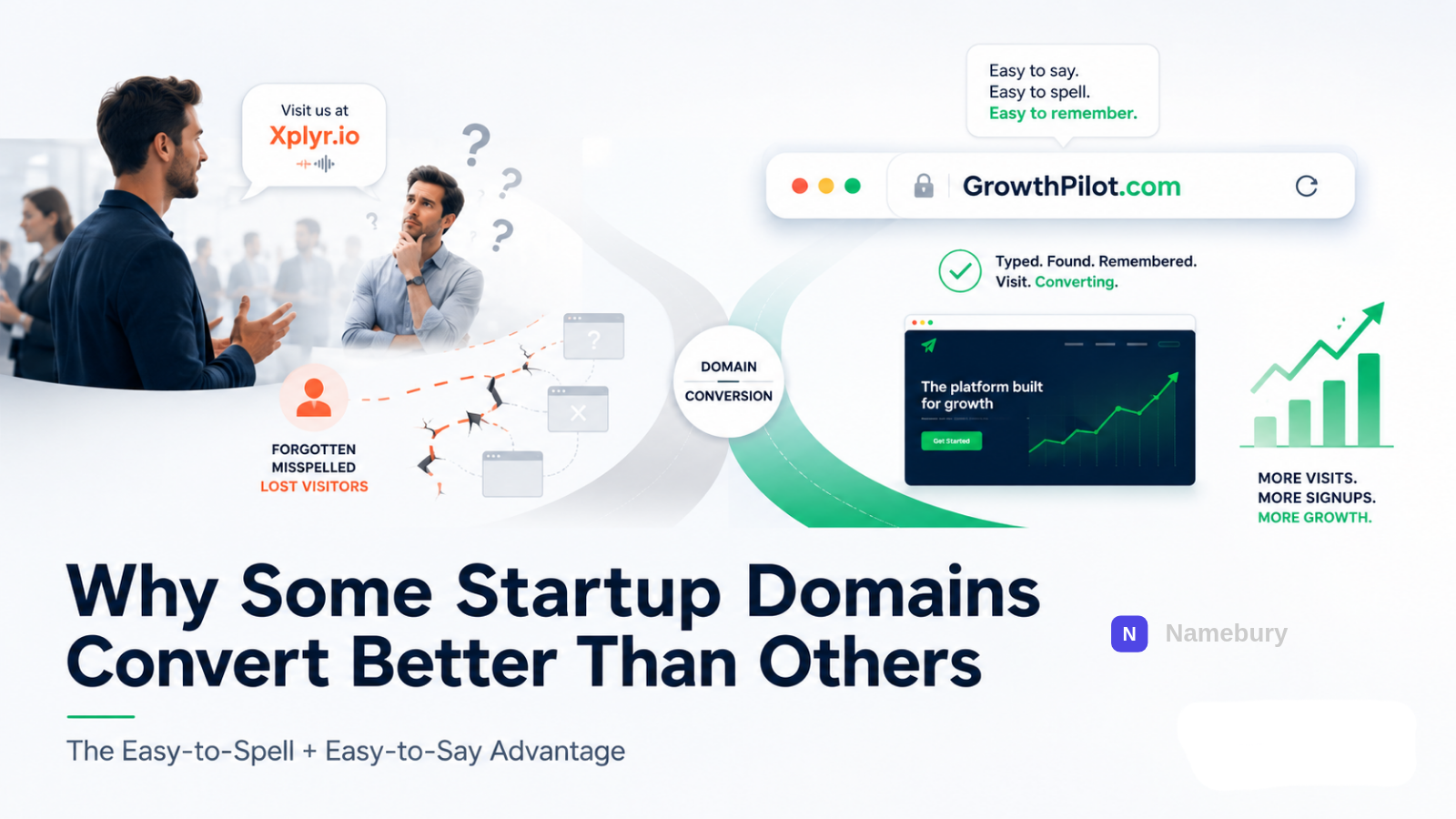
Imagine meeting a potential customer at a conference. They ask for your website. You say the name once. They immediately ask, “Can you spell that?”
That is a conversion leak.
Every clarification introduces friction. Every repeated explanation creates a chance for confusion. Every moment of hesitation increases the odds that the person never visits your site at all.
Founders often treat domain names as a branding decision only. But in practice, a domain also affects discoverability, recall, referrals, and direct traffic. In other words, a domain name is not just a brand asset. It is a conversion asset.
Why Domain Names Affect Conversion More Than Founders Think
Many startup domains fail long before a visitor lands on the homepage. The problem is not design, messaging, or product quality. The problem is that the person never makes it to the website.
This happens more often than founders realize in situations like:
- Word-of-mouth referrals
- Podcast mentions
- Networking events
- Social sharing
- Offline conversations
If someone hears your brand name, forgets the spelling, and gives up, that lost visit never shows up clearly in analytics. But it still affects growth.
A visitor who forgets your spelling never reaches your website. The best domains reduce cognitive load. They make it easy for people to hear, process, remember, and type your name without effort.
That simplicity compounds across every channel where your brand is shared verbally or remembered imperfectly.
The Easy-to-Say Test
Ask a simple question: Can a stranger pronounce your domain correctly on first sight?
The best startup domains usually pass this test immediately. Consider names like Dropbox, Slack, Stripe, and Zoom. They are short, clear, and easy to say out loud.
Problems usually appear when founders choose names with:
- Unusual letter combinations
- Forced spellings
- Missing vowels
- Invented pronunciations
Take a name like Xplyr. How is that supposed to be pronounced? Ex-player? Z-player? Explier? Nobody knows.
If your audience cannot confidently say your domain, they are less likely to share it. That hurts referrals, conversations, and memorability.
The Easy-to-Spell Test
Next question: Can someone spell your domain after hearing it once?
This matters because many real-world visits begin with audio, not text. Someone hears your brand in a meeting, on a call, in a video, or from a friend. If they cannot spell it, they may never find you.
Green flags include:
- Common words
- Familiar sounds
- Standard spelling
Red flags include:
- Double letters
- Silent letters
- Replaced vowels
- Creative spelling
Compare these examples:
Harder: Lyfft, Klykk, Qwikly
Easier: Launchpad, Growthpilot, Teamforge
The easier names create less uncertainty. The harder names force the listener to guess, and guessing is where conversions disappear.
The Phone Call Test
One of the most useful exercises for founders is the phone call test.
Tell someone your domain verbally. Then notice what happens.
If you must explain any of the following, you probably failed the test:
- Hyphens
- Numbers
- Unusual spelling
- Alternative endings
For example:
Bad: “Visit us at GetSmartly.io. That’s Smartly with two Ts and .io.”
Good: “Visit us at GrowthPilot.com.”
No clarification needed.
That is the standard to aim for. A strong domain should travel cleanly through speech. If it requires instructions, it creates friction at exactly the moment interest is highest.
The Radio Test
Now imagine hearing the domain once in a:
- Podcast
- Webinar
- YouTube interview
- Conference talk
Could you type it correctly later?
If not, your future customers probably cannot either.
This is the radio test: a domain should survive a single exposure in an audio-first context. If a listener has to pause and wonder about spelling, punctuation, or extension details, the domain is doing less conversion work than it should.
The Memory Gap Problem
Most founders assume people hear a brand and immediately visit the website. Reality is messier.
People often hear your startup name, think it sounds interesting, and search for it hours later. Sometimes they do it the next day. Sometimes they try to remember it after a meeting, during a commute, or while cleaning out their inbox.
This is where domain quality matters even more.
Easy names survive memory decay. Complex names disappear.
There are a few reasons for this:
- Recall: Can someone bring the name to mind later without assistance?
- Cognitive load: Does the name require extra mental effort to store and reproduce?
- Recognition vs. recollection: A person may recognize your brand when they see it, but still fail to recall it accurately when they need to type it.
A domain that is clear, pronounceable, and conventionally spelled has a much better chance of surviving the memory gap. That means more direct visits, more successful searches, and fewer lost prospects.
The 10-Point Domain Conversion Checklist
Use this checklist to evaluate whether your domain helps or hurts conversion.
Pronunciation
- □ Easy to say
- □ One obvious pronunciation
- □ No explanation needed
Spelling
- □ Easy to spell
- □ No unusual letter swaps
- □ No repeated clarification
Memorability
- □ Can remember after one exposure
- □ Can type later
- □ Works in conversation
- □ Works in podcasts
Brandability
- □ Sounds like a real company
If your domain misses several of these points, there is a good chance it is creating avoidable friction.
Real Founder Mistakes
| Problem | Example | Why It Increases Friction |
|---|---|---|
| Missing vowels | Grphly | People struggle to pronounce it, remember it, and reconstruct the spelling later. |
| Replaced letters | Phyndr | Listeners must guess which letters were swapped, increasing spelling errors. |
| Double letters | Appplify | Extra repeated letters are easy to miss or misremember. |
| Number substitutions | Cr8labs | Numbers force interpretation and create uncertainty in spoken referrals. |
| Hyphens | Growth-Pilot | Hyphens require explanation and are commonly forgotten when typing. |
Each of these patterns adds friction. None of them make conversion easier. They may feel clever during brainstorming, but they often underperform in real-world sharing.
The Best Domain Names Require No Instructions
A useful rule is this: If someone needs help spelling your domain, your domain is doing less work than it should.
The strongest domains are not necessarily the most creative. They are the ones people can:
- Hear
- Remember
- Spell
- Type
- Share
And they can do all of that without asking a single follow-up question.
That is why some startup domains convert better than others. They remove friction before the click ever happens.
If you are evaluating names, it helps to think practically, not just creatively. A domain should support growth in conversations, referrals, search, and memory. It should make your startup easier to find, not harder.
At Namebury, that is the core message behind strong startup naming: a domain name is not just a brand asset. It is a conversion asset.